

- Inicio
- >
- Institucional
- >
- Acceso Abierto USS
- >
- Ver ítem
JavaScript is disabled for your browser. Some features of this site may not work without it.
Descubre información por...
Buscar documentos por...
Mostrar el registro sencillo del ítem
| dc.contributor.author | Moreno, Francisco | |
| dc.contributor.author | Forcael Durán, Eric Fabián | |
| dc.contributor.author | Orozco, Francisco | |
| dc.contributor.author | Baesler Abufarde, Felipe Fabián | |
| dc.contributor.author | Agdas, Duzgun | |
| dc.date.accessioned | 2026-02-08T03:26:23Z | |
| dc.date.available | 2026-02-08T03:26:23Z | |
| dc.date.issued | 2025-01-30 | |
| dc.identifier.issn | 2405-8440 | |
| dc.identifier.uri | https://repositorio.uss.cl/handle/uss/20344 | |
| dc.description | Publisher Copyright: © 2025 | |
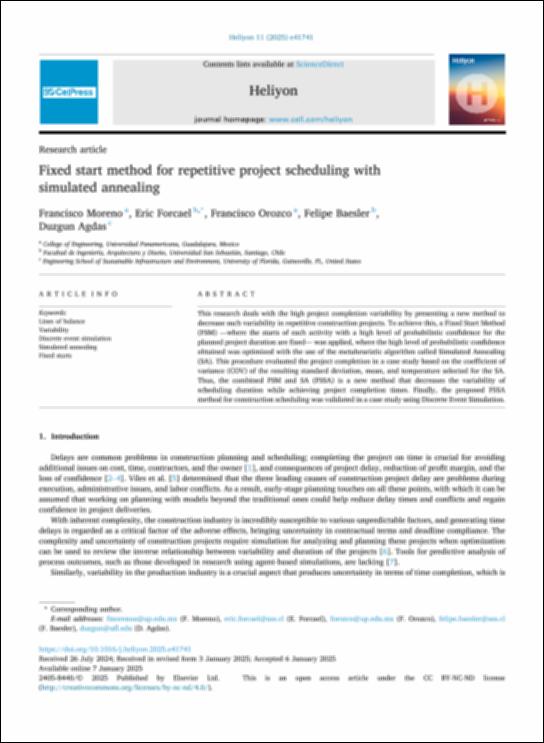
| dc.description.abstract | This research deals with the high project completion variability by presenting a new method to decrease such variability in repetitive construction projects. To achieve this, a Fixed Start Method (FSM) —where the starts of each activity with a high level of probabilistic confidence for the planned project duration are fixed— was applied, where the high level of probabilistic confidence obtained was optimized with the use of the metaheuristic algorithm called Simulated Annealing (SA). This procedure evaluated the project completion in a case study based on the coefficient of variance (COV) of the resulting standard deviation, mean, and temperature selected for the SA. Thus, the combined FSM and SA (FSSA) is a new method that decreases the variability of scheduling duration while achieving project completion times. Finally, the proposed FSSA method for construction scheduling was validated in a case study using Discrete Event Simulation. | en |
| dc.language.iso | eng | |
| dc.relation.ispartof | vol. 11 Issue: no. 2 Pages: 1-21 | |
| dc.source | Heliyon | |
| dc.title | Fixed start method for repetitive project scheduling with simulated annealing | en |
| dc.type | Artículo | |
| dc.identifier.doi | 10.1016/j.heliyon.2025.e41741 | |
| dc.publisher.department | Facultad de Ingeniería |
Este ítem aparece en la(s) siguiente(s) colección(ones)
-
Acceso Abierto USS [3006]