

- Inicio
- >
- Institucional
- >
- Acceso Abierto USS
- >
- Ver ítem
JavaScript is disabled for your browser. Some features of this site may not work without it.
Descubre información por...
Buscar documentos por...
Mostrar el registro sencillo del ítem
| dc.contributor.author | Crockett, Marcelo A. | |
| dc.contributor.author | Núñez, Daniel | |
| dc.contributor.author | Martínez, Pablo | |
| dc.contributor.author | Borghero, Francesca | |
| dc.contributor.author | Campos, Susana | |
| dc.contributor.author | Langer, Álvaro I. | |
| dc.contributor.author | Carrasco, Jimena | |
| dc.contributor.author | Martínez, Vania | |
| dc.date.accessioned | 2026-02-08T03:26:52Z | |
| dc.date.available | 2026-02-08T03:26:52Z | |
| dc.date.issued | 2025-01-15 | |
| dc.identifier.issn | 2574-3805 | |
| dc.identifier.other | Mendeley: 4d218e7d-c91a-3b72-98eb-a26b0392f8cc | |
| dc.identifier.uri | https://repositorio.uss.cl/handle/uss/20369 | |
| dc.description | Publisher Copyright: ©2025 Crockett MA et al. | |
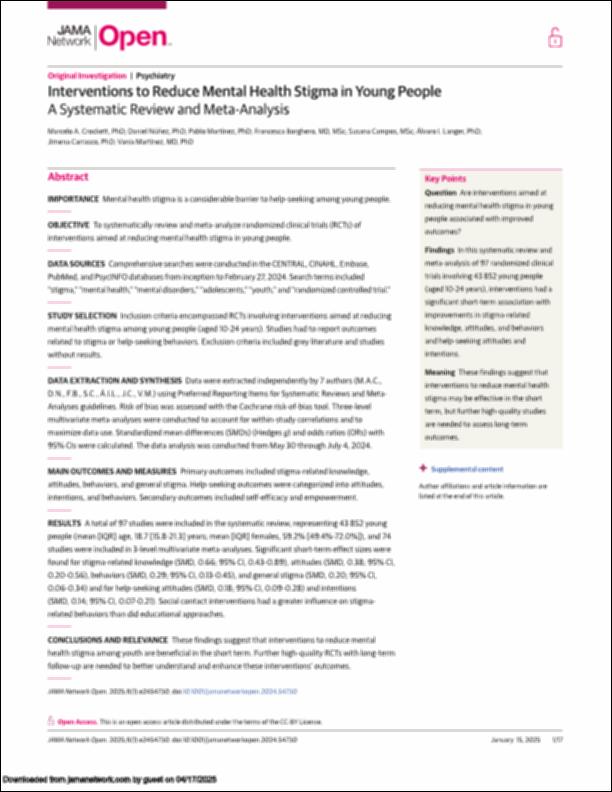
| dc.description.abstract | Importance: Mental health stigma is a considerable barrier to help-seeking among young people. Objective: To systematically review and meta-analyze randomized clinical trials (RCTs) of interventions aimed at reducing mental health stigma in young people. Data Sources: Comprehensive searches were conducted in the CENTRAL, CINAHL, Embase, PubMed, and PsycINFO databases from inception to February 27, 2024. Search terms included "stigma,""mental health,""mental disorders,""adolescents,""youth,"and "randomized controlled trial."Study Selection: Inclusion criteria encompassed RCTs involving interventions aimed at reducing mental health stigma among young people (aged 10-24 years). Studies had to report outcomes related to stigma or help-seeking behaviors. Exclusion criteria included grey literature and studies without results. Data Extraction and Synthesis: Data were extracted independently by 7 authors (M.A.C., D.N., F.B., S.C., Á.I.L., J.C., V.M.) using Preferred Reporting Items for Systematic Reviews and Meta-Analyses guidelines. Risk of bias was assessed with the Cochrane risk-of-bias tool. Three-level multivariate meta-analyses were conducted to account for within-study correlations and to maximize data use. Standardized mean differences (SMDs) (Hedges g) and odds ratios (ORs) with 95% CIs were calculated. The data analysis was conducted from May 30 through July 4, 2024. Main Outcomes and Measures: Primary outcomes included stigma-related knowledge, attitudes, behaviors, and general stigma. Help-seeking outcomes were categorized into attitudes, intentions, and behaviors. Secondary outcomes included self-efficacy and empowerment. Results: A total of 97 studies were included in the systematic review, representing 43852 young people (mean [IQR] age, 18.7 [15.8-21.3] years; mean [IQR] females, 59.2% [49.4%-72.0%]), and 74 studies were included in 3-level multivariate meta-analyses. Significant short-term effect sizes were found for stigma-related knowledge (SMD, 0.66; 95% CI, 0.43-0.89), attitudes (SMD, 0.38; 95% CI, 0.20-0.56), behaviors (SMD, 0.29; 95% CI, 0.13-0.45), and general stigma (SMD, 0.20; 95% CI, 0.06-0.34) and for help-seeking attitudes (SMD, 0.18; 95% CI, 0.09-0.28) and intentions (SMD, 0.14; 95% CI, 0.07-0.21). Social contact interventions had a greater influence on stigma-related behaviors than did educational approaches. Conclusions and Relevance: These findings suggest that interventions to reduce mental health stigma among youth are beneficial in the short term. Further high-quality RCTs with long-term follow-up are needed to better understand and enhance these interventions' outcomes. | en |
| dc.language.iso | eng | |
| dc.relation.ispartof | vol. 8 Issue: no. 1 Pages: e2454730 | |
| dc.source | JAMA network open | |
| dc.title | Interventions to Reduce Mental Health Stigma in Young People : A Systematic Review and Meta-Analysis | en |
| dc.type | Artículo | |
| dc.identifier.doi | 10.1001/jamanetworkopen.2024.54730 | |
| dc.publisher.department | Facultad de Psicología y Humanidades |
Este ítem aparece en la(s) siguiente(s) colección(ones)
-
Acceso Abierto USS [3006]