

- Inicio
- >
- Institucional
- >
- Acceso Abierto USS
- >
- Ver ítem
JavaScript is disabled for your browser. Some features of this site may not work without it.
Descubre información por...
Buscar documentos por...
Mostrar el registro sencillo del ítem
| dc.contributor.author | Hidalgo, Miltha | |
| dc.contributor.author | Railef, Bárbara | |
| dc.contributor.author | Rodríguez, Vania | |
| dc.contributor.author | Navarro, Carolina | |
| dc.contributor.author | Rubio, Vanessa | |
| dc.contributor.author | Meneses-Pacheco, Jorge | |
| dc.contributor.author | Soto-Alarcón, Sandra | |
| dc.contributor.author | Kreindl, Christine | |
| dc.contributor.author | Añazco, Carolina | |
| dc.contributor.author | Zuñiga, Leandro | |
| dc.contributor.author | Porras, Omar | |
| dc.date.accessioned | 2026-02-08T03:26:59Z | |
| dc.date.available | 2026-02-08T03:26:59Z | |
| dc.date.issued | 2025-03 | |
| dc.identifier.issn | 2213-2317 | |
| dc.identifier.other | Mendeley: c9d07860-0a0d-36de-94a2-cb3991e10c19 | |
| dc.identifier.uri | https://repositorio.uss.cl/handle/uss/20374 | |
| dc.description | Publisher Copyright: © 2025 The Authors | |
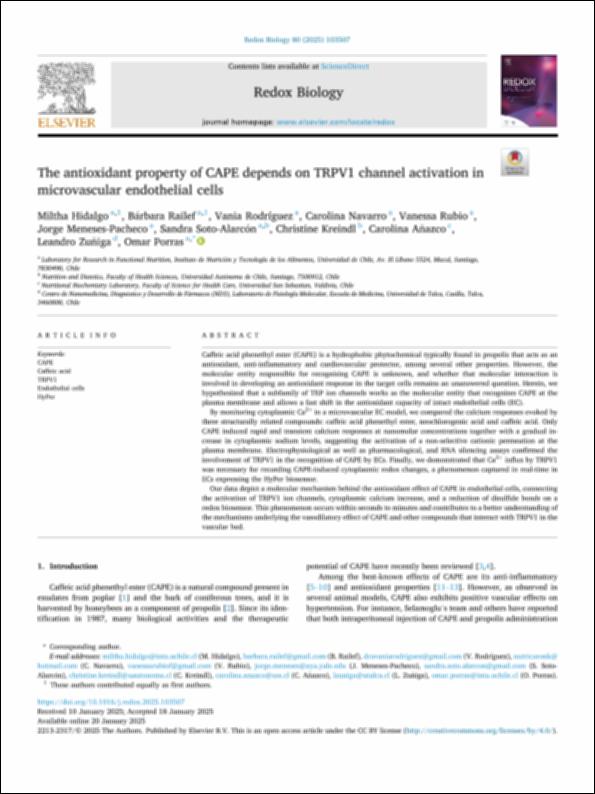
| dc.description.abstract | Caffeic acid phenethyl ester (CAPE) is a hydrophobic phytochemical typically found in propolis that acts as an antioxidant, anti-inflammatory and cardiovascular protector, among several other properties. However, the molecular entity responsible for recognising CAPE is unknown, and whether that molecular interaction is involved in developing an antioxidant response in the target cells remains an unanswered question. Herein, we hypothesized that a subfamily of TRP ion channels works as the molecular entity that recognizes CAPE at the plasma membrane and allows a fast shift in the antioxidant capacity of intact endothelial cells (EC). By monitoring cytoplasmic Ca2+ in a microvascular EC model, we compared the calcium responses evoked by three structurally related compounds: caffeic acid phenethyl ester, neochlorogenic acid and caffeic acid. Only CAPE induced rapid and transient calcium responses at nanomolar concentrations together with a gradual increase in cytoplasmic sodium levels, suggesting the activation of a non-selective cationic permeation at the plasma membrane. Electrophysiological as well as pharmacological, and RNA silencing assays confirmed the involvement of TRPV1 in the recognition of CAPE by ECs. Finally, we demonstrated that Ca2+ influx by TRPV1 was necessary for recording CAPE-induced cytoplasmic redox changes, a phenomenon captured in real-time in ECs expressing the HyPer biosensor. Our data depict a molecular mechanism behind the antioxidant effect of CAPE in endothelial cells, connecting the activation of TRPV1 ion channels, cytoplasmic calcium increase, and a reduction of disulfide bonds on a redox biosensor. This phenomenon occurs within seconds to minutes and contributes to a better understanding of the mechanisms underlying the vasodilatory effect of CAPE and other compounds that interact with TRPV1 in the vascular bed. | en |
| dc.language.iso | eng | |
| dc.relation.ispartof | vol. 80 Issue: Pages: | |
| dc.source | Redox Biology | |
| dc.title | The antioxidant property of CAPE depends on TRPV1 channel activation in microvascular endothelial cells | en |
| dc.type | Artículo | |
| dc.identifier.doi | 10.1016/j.redox.2025.103507 | |
| dc.publisher.department | Facultad de Ciencias de la Rehabilitación y Calidad de Vida |
Este ítem aparece en la(s) siguiente(s) colección(ones)
-
Acceso Abierto USS [3006]