

- Inicio
- >
- Institucional
- >
- Acceso Abierto USS
- >
- Ver ítem
JavaScript is disabled for your browser. Some features of this site may not work without it.
Descubre información por...
Buscar documentos por...
Mostrar el registro sencillo del ítem
| dc.contributor.author | Caamaño-Naverrete, Felipe | |
| dc.contributor.author | Del-Cuerpo, Indya | |
| dc.contributor.author | Arriagada-Hernández, Carlos | |
| dc.contributor.author | Cresp Barria, Mauricio | |
| dc.contributor.author | Hernández Mosqueira, Claudio | |
| dc.contributor.author | Contreras Díaz, Guido Edgardo | |
| dc.contributor.author | Valdés Badilla, Pablo | |
| dc.contributor.author | Jerez Mayorga, Daniel | |
| dc.contributor.author | Delgado Floody, Pedro | |
| dc.date.accessioned | 2026-02-08T03:27:27Z | |
| dc.date.available | 2026-02-08T03:27:27Z | |
| dc.date.issued | 2025-02-22 | |
| dc.identifier.issn | 2227-9067 | |
| dc.identifier.uri | https://repositorio.uss.cl/handle/uss/20390 | |
| dc.description | Publisher Copyright: © 2025 by the authors. | |
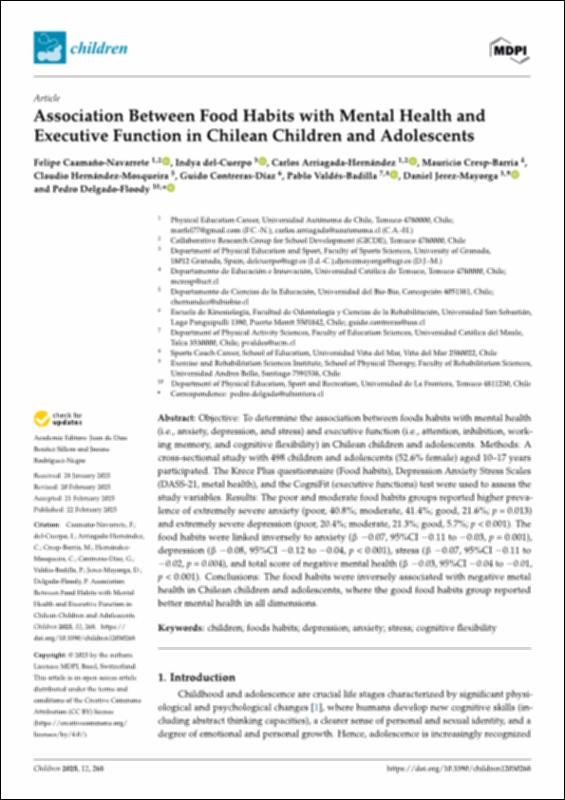
| dc.description.abstract | Objective: To determine the association between foods habits with mental health (i.e., anxiety, depression, and stress) and executive function (i.e., attention, inhibition, working memory, and cognitive flexibility) in Chilean children and adolescents. Methods: A cross-sectional study with 498 children and adolescents (52.6% female) aged 10–17 years participated. The Krece Plus questionnaire (Food habits), Depression Anxiety Stress Scales (DASS-21, metal health), and the CogniFit (executive functions) test were used to assess the study variables. Results: The poor and moderate food habits groups reported higher prevalence of extremely severe anxiety (poor, 40.8%; moderate, 41.4%; good, 21.6%; p = 0.013) and extremely severe depression (poor, 20.4%; moderate, 21.3%; good, 5.7%; p < 0.001). The food habits were linked inversely to anxiety (β −0.07, 95%CI −0.11 to −0.03, p = 0.001), depression (β −0.08, 95%CI −0.12 to −0.04, p < 0.001), stress (β −0.07, 95%CI −0.11 to −0.02, p = 0.004), and total score of negative mental health (β −0.03, 95%CI −0.04 to −0.01, p < 0.001). Conclusions: The food habits were inversely associated with negative metal health in Chilean children and adolescents, where the good food habits group reported better mental health in all dimensions. | es |
| dc.language.iso | eng | |
| dc.relation.ispartof | vol. 12 Issue: no. 3 Pages: | |
| dc.source | Children | |
| dc.title | Association Between Food Habits with Mental Health and Executive Function in Chilean Children and Adolescents | en |
| dc.title.alternative | Asociación entre los hábitos alimentarios con la salud mental y la función ejecutiva en niños y adolescentes chilenos | es |
| dc.type | Artículo | |
| dc.identifier.doi | 10.3390/children12030268 | |
| dc.publisher.department | Facultad de Ciencias de la Rehabilitación y Calidad de Vida |
Este ítem aparece en la(s) siguiente(s) colección(ones)
-
Acceso Abierto USS [3006]