

- Inicio
- >
- Institucional
- >
- Acceso Abierto USS
- >
- Ver ítem
JavaScript is disabled for your browser. Some features of this site may not work without it.
Descubre información por...
Buscar documentos por...
Mostrar el registro sencillo del ítem
| dc.contributor.author | Moroni Orellana, Ginnia Constanza | |
| dc.contributor.author | Forcael Durán, Eric Fabián | |
| dc.date.accessioned | 2026-02-08T03:27:59Z | |
| dc.date.available | 2026-02-08T03:27:59Z | |
| dc.date.issued | 2025-03 | |
| dc.identifier.issn | 2075-5309 | |
| dc.identifier.uri | https://repositorio.uss.cl/handle/uss/20415 | |
| dc.description | Publisher Copyright: © 2025 by the authors. | |
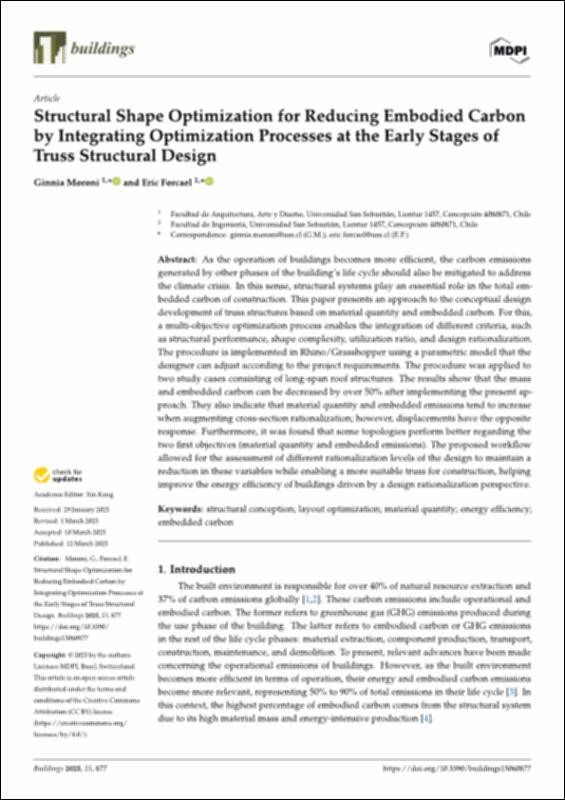
| dc.description.abstract | As the operation of buildings becomes more efficient, the carbon emissions generated by other phases of the building’s life cycle should also be mitigated to address the climate crisis. In this sense, structural systems play an essential role in the total embedded carbon of construction. This paper presents an approach to the conceptual design development of truss structures based on material quantity and embedded carbon. For this, a multi-objective optimization process enables the integration of different criteria, such as structural performance, shape complexity, utilization ratio, and design rationalization. The procedure is implemented in Rhino/Grasshopper using a parametric model that the designer can adjust according to the project requirements. The procedure was applied to two study cases consisting of long-span roof structures. The results show that the mass and embedded carbon can be decreased by over 50% after implementing the present approach. They also indicate that material quantity and embedded emissions tend to increase when augmenting cross-section rationalization; however, displacements have the opposite response. Furthermore, it was found that some topologies perform better regarding the two first objectives (material quantity and embedded emissions). The proposed workflow allowed for the assessment of different rationalization levels of the design to maintain a reduction in these variables while enabling a more suitable truss for construction, helping improve the energy efficiency of buildings driven by a design rationalization perspective. | en |
| dc.language.iso | eng | |
| dc.relation.ispartof | vol. 15 Issue: no. 6 Pages: 1-17 | |
| dc.source | Buildings | |
| dc.title | Structural Shape Optimization for Reducing Embodied Carbon by Integrating Optimization Processes at the Early Stages of Truss Structural Design | en |
| dc.type | Artículo | |
| dc.identifier.doi | 10.3390/buildings15060877 | |
| dc.publisher.department | Facultad de Ingeniería | |
| dc.publisher.department | Facultad de Arquitectura, Arte y Diseño |
Este ítem aparece en la(s) siguiente(s) colección(ones)
-
Acceso Abierto USS [3006]