

- Inicio
- >
- Institucional
- >
- Acceso Abierto USS
- >
- Ver ítem
JavaScript is disabled for your browser. Some features of this site may not work without it.
Descubre información por...
Buscar documentos por...
Mostrar el registro sencillo del ítem
| dc.contributor.author | Gallardo, Felipe S. | |
| dc.contributor.author | Cruz-Soca, Meilyn | |
| dc.contributor.author | Bock-Pereda, Alexia | |
| dc.contributor.author | Faundez-Contreras, Jennifer | |
| dc.contributor.author | Gutierrez-Rojas, Cristian | |
| dc.contributor.author | Gandin, Alessandro | |
| dc.contributor.author | Torresan, Veronica | |
| dc.contributor.author | Casar, Juan Carlos | |
| dc.contributor.author | Ravasio, Andrea | |
| dc.contributor.author | Brandan, Enrique | |
| dc.date.accessioned | 2026-02-08T03:28:30Z | |
| dc.date.available | 2026-02-08T03:28:30Z | |
| dc.date.issued | 2025-03 | |
| dc.identifier.issn | 0363-6143 | |
| dc.identifier.other | Mendeley: f6ac86eb-e993-3490-8c86-1898a8e608fc | |
| dc.identifier.uri | https://repositorio.uss.cl/handle/uss/20440 | |
| dc.description | Publisher Copyright: Copyright © 2025 the American Physiological Society. | |
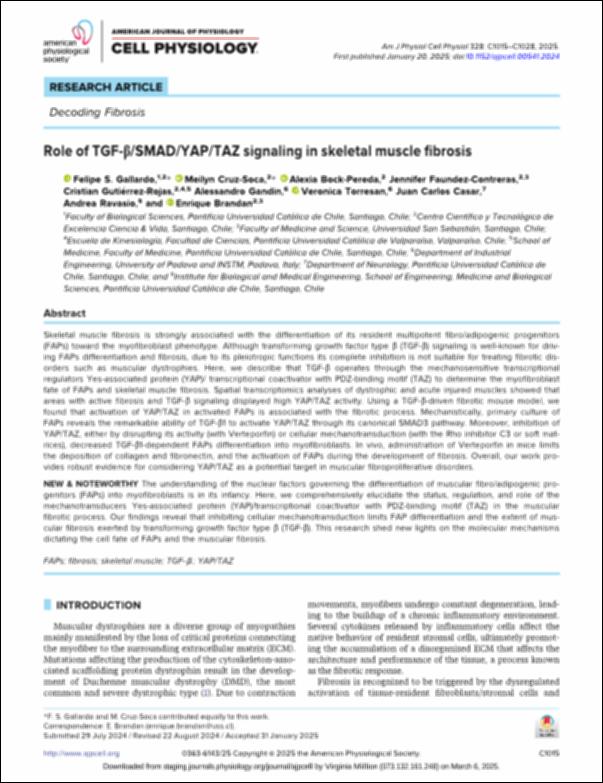
| dc.description.abstract | Skeletal muscle fibrosis is strongly associated with the differentiation of its resident multipotent fibro/adipogenic progenitors (FAPs) toward the myofibroblast phenotype. Although transforming growth factor type b (TGF-b) signaling is well-known for driving FAPs differentiation and fibrosis, due to its pleiotropic functions its complete inhibition is not suitable for treating fibrotic disorders such as muscular dystrophies. Here, we describe that TGF-b operates through the mechanosensitive transcriptional regulators Yes-associated protein (YAP)/ transcriptional coactivator with PDZ-binding motif (TAZ) to determine the myofibroblast fate of FAPs and skeletal muscle fibrosis. Spatial transcriptomics analyses of dystrophic and acute injured muscles showed that areas with active fibrosis and TGF-b signaling displayed high YAP/TAZ activity. Using a TGF-b-driven fibrotic mouse model, we found that activation of YAP/TAZ in activated FAPs is associated with the fibrotic process. Mechanistically, primary culture of FAPs reveals the remarkable ability of TGF-b1 to activate YAP/TAZ through its canonical SMAD3 pathway. Moreover, inhibition of YAP/TAZ, either by disrupting its activity (with Verteporfin) or cellular mechanotransduction (with the Rho inhibitor C3 or soft matrices), decreased TGF-b1-dependent FAPs differentiation into myofibroblasts. In vivo, administration of Verteporfin in mice limits the deposition of collagen and fibronectin, and the activation of FAPs during the development of fibrosis. Overall, our work provides robust evidence for considering YAP/TAZ as a potential target in muscular fibroproliferative disorders. | en |
| dc.description.abstract | Skeletal muscle fibrosis is strongly associated with the differentiation of its resident multipotent fibro/adipogenic progenitors (FAPs) towards the myofibroblast phenotype. Although TGF-β signaling is well-known for driving FAPs differentiation and fibrosis, due to its pleiotropic functions its complete inhibition is not suitable for treating fibrotic disorders such as muscular dystrophies. Here, we describe that TGF-β operates through the mechanosensitive transcriptional regulators YAP/TAZ to determine the myofibroblast fate of FAPs and skeletal muscle fibrosis. Spatial transcriptomics analyses of dystrophic and acute injured muscles showed that areas with active fibrosis and TGF-β signaling displayed high YAP/TAZ activity. Using a TGF-β-driven fibrotic mouse model, we found that activation of YAP/TAZ in activated FAPs is associated with the fibrotic process. Mechanistically, primary culture of FAPs reveals the remarkable ability of TGF-β1 to activate YAP/TAZ through its canonical SMAD3 pathway. Moreover, inhibition of YAP/TAZ, either by disrupting its activity (with Verteporfin) or cellular mechanotransduction (with the Rho inhibitor C3 or soft matrices), decreased TGF-β1-dependent FAPs differentiation into myofibroblasts. In vivo, administration of Verteporfin in mice limits the deposition of collagen and fibronectin, and the activation of FAPs during the development of fibrosis. Overall, our work provides robust evidence for considering YAP/TAZ as a potential target in muscular fibroproliferative disorders. | es |
| dc.language.iso | eng | |
| dc.relation.ispartof | vol. 328 Issue: no. 3 Pages: C1015-C1028 | |
| dc.source | American Journal of Physiology - Cell Physiology | |
| dc.title | Role of TGF-β/SMAD/YAP/TAZ signaling in skeletal muscle fibrosis. | en |
| dc.type | Artículo | |
| dc.identifier.doi | 10.1152/ajpcell.00541.2024 | |
| dc.publisher.department | Facultad de Medicina |
Este ítem aparece en la(s) siguiente(s) colección(ones)
-
Acceso Abierto USS [3006]