

- Inicio
- >
- Institucional
- >
- Acceso Abierto USS
- >
- Ver ítem
JavaScript is disabled for your browser. Some features of this site may not work without it.
Descubre información por...
Buscar documentos por...

Temporalmente, el archivo digital asociado a esta publicación, no se encuentra disponible. Para más información escribir a [email protected]
Este documento se encuentra disponible en su fuente de origen, si desea acceder al texto completo, puedes hacerlo a continuación:
Poly (I:C)-induced inflammation requires the activation of toll-like receptor 3/Ca<sup>2+</sup>/CaMKII/pannexin 1-dependent signaling
|
Autor(es)
Salgado, Magdiel; Sepúlveda-Arriagada, Vania; Konar-Nié, Macarena; García-Robles, María A.; Sáez, Juan C. |
|
ISSN:
1838-7640 |
|
Idioma:
eng |
|
Fecha:
2025-01-20 |
|
Tipo:
Artículo |
|
Revista:
Theranostics |
|
Datos de la publicación:
vol. 15 Issue: no. 6 Pages: 2470-2486 |
|
DOI:
10.7150/thno.100687 |
|
Descripción:
Publisher Copyright: © The author(s). |
|
Resumen:
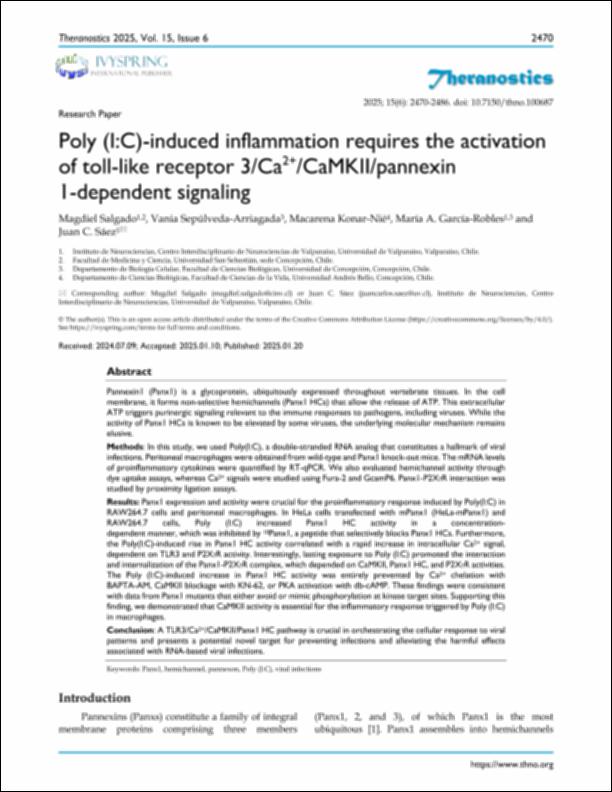
Pannexin1 (Panx1) is a glycoprotein, ubiquitously expressed throughout vertebrate tissues. In the cell membrane, it forms non-selective hemichannels (Panx1 HCs) that allow the release of ATP. This extracellular ATP triggers purinergic signaling relevant to the immune responses to pathogens, including viruses. While the activity of Panx1 HCs is known to be elevated by some viruses, the underlying molecular mechanism remains elusive. Methods: In this study, we used Poly(I:C), a double-stranded RNA analog that constitutes a hallmark of viral infections. Peritoneal macrophages were obtained from wild-type and Panx1 knock-out mice. The mRNA levels of proinflammatory cytokines were quantified by RT-qPCR. We also evaluated hemichannel activity through dye uptake assays, whereas Ca 2+ signals were studied using Fura-2 and GcamP6. Panx1-P2X7R interaction was studied by proximity ligation assays. Results: Panx1 expression and activity were crucial for the proinflammatory response induced by Poly(I:C) in RAW264.7 cells and peritoneal macrophages. In HeLa cells transfected with mPanx1 (HeLa-mPanx1) and RAW264.7 cells, Poly (I:C) increased Panx1 HC activity in a concentration-dependent manner, which was inhibited by 10Panx1, a peptide that selectively blocks Panx1 HCs. Furthermore, the Poly(I:C)-induced rise in Panx1 HC activity correlated with a rapid increase in intracellular Ca 2+ signal, dependent on TLR3 and P2X7R activity. Interestingly, lasting exposure to Poly (I:C) promoted the interaction and internalization of the Panx1-P2X7R complex, which depended on CaMKII, Panx1 HC, and P2X7R activities. The Poly (I:C)-induced increase in Panx1 HC activity was entirely prevented by Ca 2+ chelation with BAPTA-AM, CaMKII blockage with KN-62, or PKA activation with db-cAMP. These findings were consistent with data from Panx1 mutants that either avoid or mimic phosphorylation at kinase target sites. Supporting this finding, we demonstrated that CaMKII activity is essential for the inflammatory response triggered by Poly (I:C) in macrophages. Conclusion: A TLR3/Ca 2+/CaMKII/Panx1 HC pathway is crucial in orchestrating the cellular response to viral patterns and presents a potential novel target for preventing infections and alleviating the harmful effects associated with RNA-based viral infections. |
Este ítem aparece en la(s) siguiente(s) colección(ones)
-
Acceso Abierto USS [3006]