

- Inicio
- >
- Institucional
- >
- Acceso Abierto USS
- >
- Ver ítem
JavaScript is disabled for your browser. Some features of this site may not work without it.
Descubre información por...
Buscar documentos por...
Mostrar el registro sencillo del ítem
| dc.contributor.author | Rivera Zaldivar, Joaquin Jose | |
| dc.contributor.author | Goldsmith Weil, Jael | |
| dc.date.accessioned | 2026-02-08T03:28:49Z | |
| dc.date.available | 2026-02-08T03:28:49Z | |
| dc.date.issued | 2025-05-01 | |
| dc.identifier.issn | 0379-8682 | |
| dc.identifier.uri | https://repositorio.uss.cl/handle/uss/20453 | |
| dc.description | Publisher Copyright: © 2025, Revista de Geografia Norte Grande. All rights reserved. | |
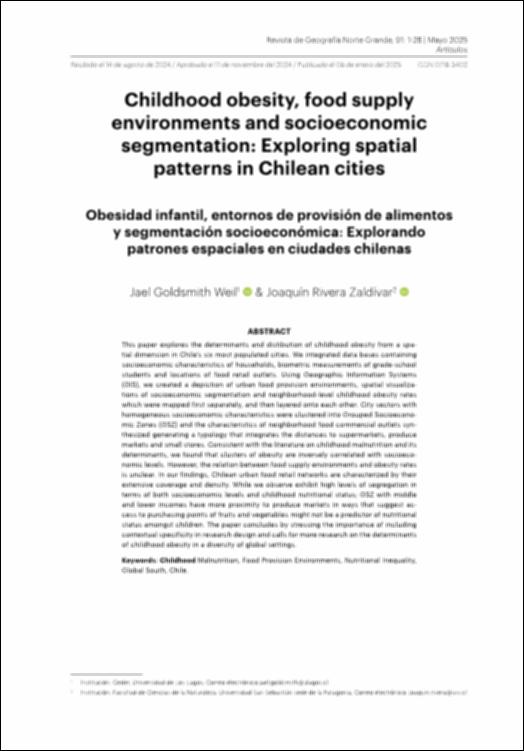
| dc.description.abstract | This paper explores the determinants and distribution childhood obesity from a spatial dimension in Chile’s six most populated cities. We integrated data bases containing socioeconomic characteristics of households, biometric measurements of grade-school students and locations of food retail outlets. Using Geographic Information Systems (GIS), we created a depiction of urban food provision environments, spatial visualizations of socioeconomic segmentation and neighborhood-level childhood obesity rates which were mapped first separately, and then layered onto each other. City sectors with homogeneous socioeconomic characteristics were clustered into Grouped Socioeconomic Zones (GSZ) and the characteristics of neighborhood food commercial outlets synthesized generating a typology that integrates the distances to supermarkets, produce markets and small stores. Consistent with the literature on childhood malnutrition and its determinants, we found that clusters of obesity are inversely correlated with socioeconomic levels. However, the relation between food supply environments and obesity rates is unclear. In our findings, Chilean urban food retail networks are characterized by their extensive coverage and density. While we observe exhibit high levels of segregation in terms of both socioeconomic levels and childhood nutritional status; GSZ with middle and lower incomes have more proximity to produce markets in ways that suggest access to purchasing points of fruits and vegetables might not be a predictor of nutritional status amongst children. The paper concludes by stressing the importance of including contextual specificity in research design and calls for more research on the determinants of childhood obesity in a diversity of global settings. | es |
| dc.language.iso | eng | |
| dc.relation.ispartof | vol. 2025 Issue: no. 91 Pages: | |
| dc.source | Revista de Geografia Norte Grande | |
| dc.title | Childhood obesity, food supply environments and socioeconomic segmentation: Exploring spatial patterns in Chilean cities | en |
| dc.type | Artículo | |
| dc.identifier.doi | 10.4067/S0718-34022025000200114 | |
| dc.publisher.department | Facultad de Economía, Negocios y Gobierno |
Este ítem aparece en la(s) siguiente(s) colección(ones)
-
Acceso Abierto USS [3006]