

- Inicio
- >
- Institucional
- >
- Acceso Abierto USS
- >
- Ver ítem
JavaScript is disabled for your browser. Some features of this site may not work without it.
Descubre información por...
Buscar documentos por...
Mostrar el registro sencillo del ítem
| dc.contributor.author | Jiménez-Ávila, Cristina | |
| dc.contributor.author | Villaquiran-Hurtado, Andrés Felipe | |
| dc.contributor.author | Jerez-Mayorga, Daniel | |
| dc.contributor.author | Contreras-Diaz, Guido | |
| dc.date.accessioned | 2026-02-08T03:30:27Z | |
| dc.date.available | 2026-02-08T03:30:27Z | |
| dc.date.issued | 2025-08 | |
| dc.identifier.issn | 1071-1007 | |
| dc.identifier.other | Mendeley: 4c41f111-e6c9-398f-a6fe-2417441b4250 | |
| dc.identifier.uri | https://repositorio.uss.cl/handle/uss/20528 | |
| dc.description | Publisher Copyright: © The Author(s) 2025. | |
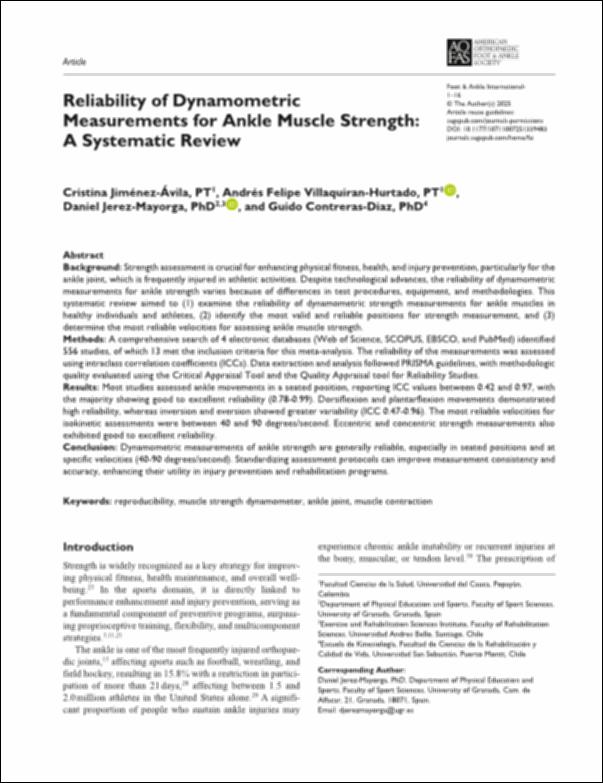
| dc.description.abstract | Background: Strength assessment is crucial for enhancing physical fitness, health, and injury prevention, particularly for the ankle joint, which is frequently injured in athletic activities. Despite technological advances, the reliability of dynamometric measurements for ankle strength varies because of differences in test procedures, equipment, and methodologies. This systematic review aimed to (1) examine the reliability of dynamometric strength measurements for ankle muscles in healthy individuals and athletes, (2) identify the most valid and reliable positions for strength measurement, and (3) determine the most reliable velocities for assessing ankle muscle strength. Methods: A comprehensive search of 4 electronic databases (Web of Science, SCOPUS, EBSCO, and PubMed) identified 556 studies, of which 13 met the inclusion criteria for this meta-analysis. The reliability of the measurements was assessed using intraclass correlation coefficients (ICCs). Data extraction and analysis followed PRISMA guidelines, with methodologic quality evaluated using the Critical Appraisal Tool and the Quality Appraisal tool for Reliability Studies. Results: Most studies assessed ankle movements in a seated position, reporting ICC values between 0.42 and 0.97, with the majority showing good to excellent reliability (0.78-0.99). Dorsiflexion and plantarflexion movements demonstrated high reliability, whereas inversion and eversion showed greater variability (ICC 0.47-0.96). The most reliable velocities for isokinetic assessments were between 40 and 90 degrees/second. Eccentric and concentric strength measurements also exhibited good to excellent reliability. Conclusion: Dynamometric measurements of ankle strength are generally reliable, especially in seated positions and at specific velocities (40-90 degrees/second). Standardizing assessment protocols can improve measurement consistency and accuracy, enhancing their utility in injury prevention and rehabilitation programs. | en |
| dc.language.iso | eng | |
| dc.relation.ispartof | vol. 46 Issue: no. 8 Pages: 925-940 | |
| dc.source | Foot and Ankle International | |
| dc.title | Reliability of Dynamometric Measurements for Ankle Muscle Strength : A Systematic Review | en |
| dc.title.alternative | Fiabilidad de las mediciones dinamométricas de la fuerza muscular del tobilloUna revisión sistemática | es |
| dc.type | Artículo | |
| dc.identifier.doi | 10.1177/10711007251339483 | |
| dc.publisher.department | Facultad de Ciencias de la Rehabilitación y Calidad de Vida |
Este ítem aparece en la(s) siguiente(s) colección(ones)
-
Acceso Abierto USS [3006]