

- Inicio
- >
- Institucional
- >
- Acceso Abierto USS
- >
- Ver ítem
JavaScript is disabled for your browser. Some features of this site may not work without it.
Descubre información por...
Buscar documentos por...
Mostrar el registro sencillo del ítem
| dc.contributor.author | Palacios Mackay, Ismael | |
| dc.contributor.author | Marín-Restrepo, Laura | |
| dc.contributor.author | Perez Fargallo, Alexis | |
| dc.date.accessioned | 2026-02-08T03:30:32Z | |
| dc.date.available | 2026-02-08T03:30:32Z | |
| dc.date.issued | 2025-05-22 | |
| dc.identifier.issn | 1996-1073 | |
| dc.identifier.uri | https://repositorio.uss.cl/handle/uss/20531 | |
| dc.description | Publisher Copyright: © 2025 by the authors. | |
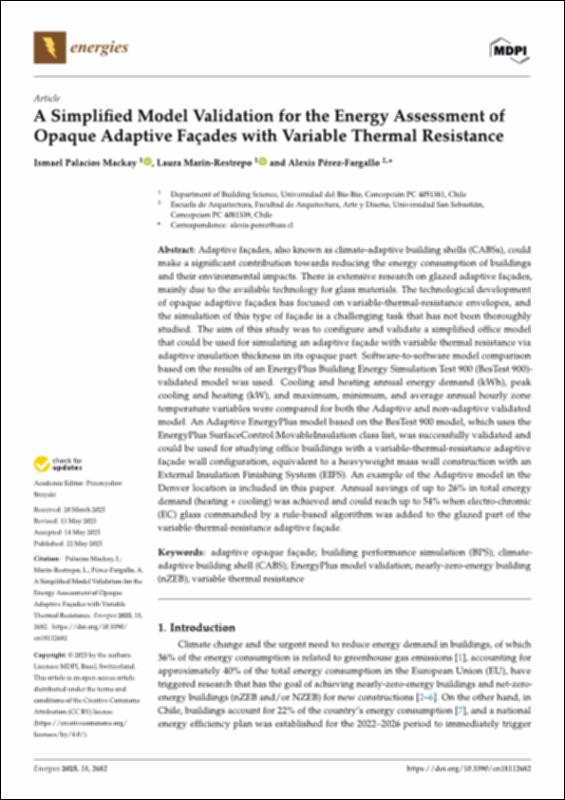
| dc.description.abstract | Adaptive façades, also known as climate-adaptive building shells (CABSs), could make a significant contribution towards reducing the energy consumption of buildings and their environmental impacts. There is extensive research on glazed adaptive façades, mainly due to the available technology for glass materials. The technological development of opaque adaptive façades has focused on variable-thermal-resistance envelopes, and the simulation of this type of façade is a challenging task that has not been thoroughly studied. The aim of this study was to configure and validate a simplified office model that could be used for simulating an adaptive façade with variable thermal resistance via adaptive insulation thickness in its opaque part. Software-to-software model comparison based on the results of an EnergyPlus Building Energy Simulation Test 900 (BesTest 900)-validated model was used. Cooling and heating annual energy demand (kWh), peak cooling and heating (kW), and maximum, minimum, and average annual hourly zone temperature variables were compared for both the Adaptive and non-adaptive validated model. An Adaptive EnergyPlus model based on the BesTest 900 model, which uses the EnergyPlus SurfaceControl:MovableInsulation class list, was successfully validated and could be used for studying office buildings with a variable-thermal-resistance adaptive façade wall configuration, equivalent to a heavyweight mass wall construction with an External Insulation Finishing System (EIFS). An example of the Adaptive model in the Denver location is included in this paper. Annual savings of up to 26% in total energy demand (heating + cooling) was achieved and could reach up to 54% when electro-chromic (EC) glass commanded by a rule-based algorithm was added to the glazed part of the variable-thermal-resistance adaptive façade. | en |
| dc.language.iso | eng | |
| dc.relation.ispartof | vol. 18 Issue: no. 11 Pages: | |
| dc.source | Energies | |
| dc.title | A Simplified Model Validation for the Energy Assessment of Opaque Adaptive Façades with Variable Thermal Resistance | en |
| dc.type | Artículo | |
| dc.identifier.doi | 10.3390/en18112682 | |
| dc.publisher.department | Facultad de Arquitectura, Arte y Diseño |
Este ítem aparece en la(s) siguiente(s) colección(ones)
-
Acceso Abierto USS [3006]