

- Inicio
- >
- Institucional
- >
- Acceso Abierto USS
- >
- Ver ítem
JavaScript is disabled for your browser. Some features of this site may not work without it.
Descubre información por...
Buscar documentos por...

Temporalmente, el archivo digital asociado a esta publicación, no se encuentra disponible. Para más información escribir a [email protected]
Este documento se encuentra disponible en su fuente de origen, si desea acceder al texto completo, puedes hacerlo a continuación:
The barriers perceived by Chilean athletes with disability at different social ecological levels
|
Autor(es)
Luarte Rocha, Cristian Eduardo; Pleticosic Ramirez, Yazmina Virginia; Castelli, Luis Felipe; Fica, Nicolas; Fernandez, Monica; Santos, Luiz; Gamonales, Jose M; Winkler, Ciro; Pena, Luis G.; Muñoz, Fernando; de Vitor, Eduardo Rossato; Martin, Pablo del Val; Ferrari, Gerson |
|
ISSN:
2045-2322 |
|
Idioma:
eng |
|
Fecha:
2025-12 |
|
Tipo:
Artículo |
|
Revista:
Scientific Reports |
|
Datos de la publicación:
vol. 15 Issue: no. 1 Pages: 1 |
|
DOI:
10.1038/s41598-025-04211-0 |
|
Descripción:
Publisher Copyright: © The Author(s) 2025. |
|
Resumen:
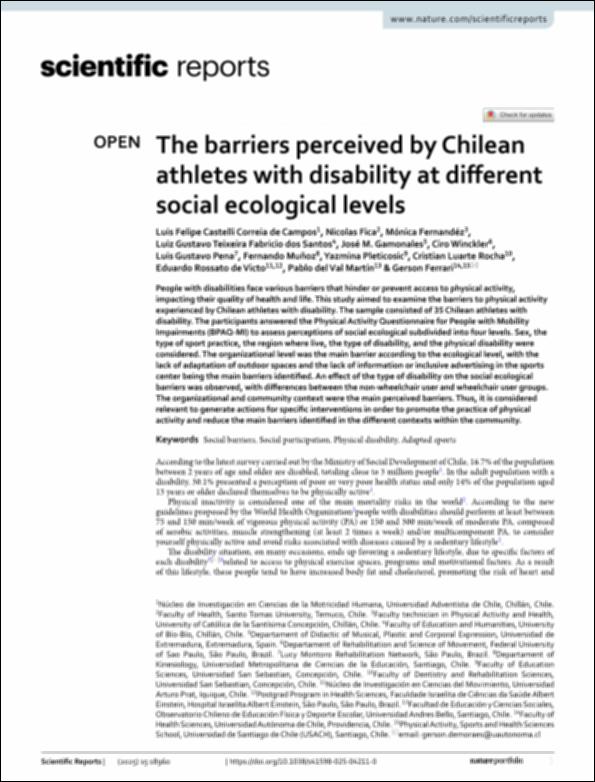
People with disabilities face various barriers that hinder or prevent access to physical activity, impacting their quality of health and life. This study aimed to examine the barriers to physical activity experienced by Chilean athletes with disability. The sample consisted of 35 Chilean athletes with disability. The participants answered the Physical Activity Questionnaire for People with Mobility Impairments (BPAQ-MI) to assess perceptions of social ecological subdivided into four levels. Sex, the type of sport practice, the region where live, the type of disability, and the physical disability were considered. The organizational level was the main barrier according to the ecological level, with the lack of adaptation of outdoor spaces and the lack of information or inclusive advertising in the sports center being the main barriers identified. An effect of the type of disability on the social ecological barriers was observed, with differences between the non-wheelchair user and wheelchair user groups. The organizational and community context were the main perceived barriers. Thus, it is considered relevant to generate actions for specific interventions in order to promote the practice of physical activity and reduce the main barriers identified in the different contexts within the community. |
Este ítem aparece en la(s) siguiente(s) colección(ones)
-
Acceso Abierto USS [3006]