

- Inicio
- >
- Institucional
- >
- Acceso Abierto USS
- >
- Ver ítem
JavaScript is disabled for your browser. Some features of this site may not work without it.
Descubre información por...
Buscar documentos por...
Mostrar el registro sencillo del ítem
| dc.contributor.author | Arias Alvarez, Gonzalo Javier | |
| dc.contributor.author | Carvajal Parodi, Claudio Jose | |
| dc.contributor.author | Guzmán Pincheira, Carla Dayana | |
| dc.contributor.author | Osorio Torres, Waldo David | |
| dc.contributor.author | González, Diego | |
| dc.contributor.author | Pecos-Martín, Daniel | |
| dc.contributor.author | Gómez-Pulido, José | |
| dc.date.accessioned | 2026-02-08T03:31:17Z | |
| dc.date.available | 2026-02-08T03:31:17Z | |
| dc.date.issued | 2025-06-26 | |
| dc.identifier.issn | 2096-5796 | |
| dc.identifier.other | Mendeley: f1d4321d-c6ba-30c6-ab13-9796cb61601a | |
| dc.identifier.uri | https://repositorio.uss.cl/handle/uss/20556 | |
| dc.description | Publisher Copyright: © 2025 Beijing Zhongke Journal Publishing Co. Ltd | |
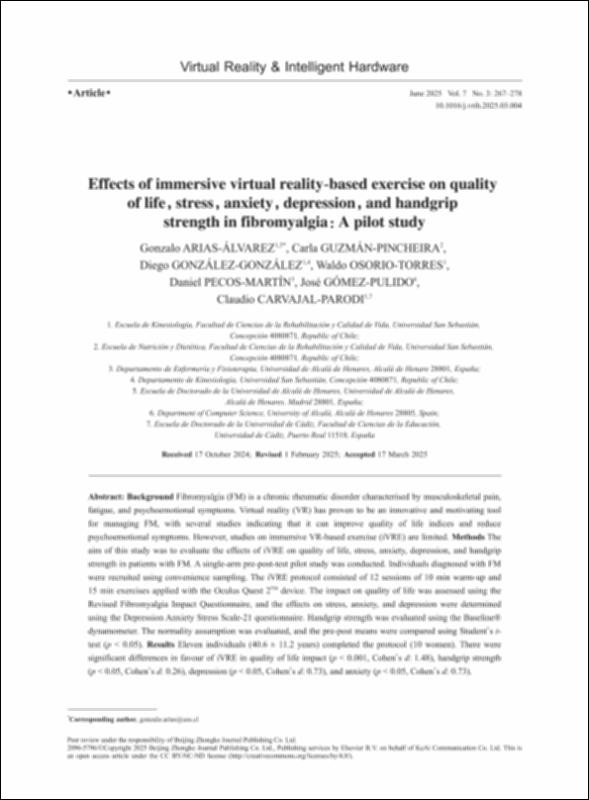
| dc.description.abstract | Background: Fibromyalgia (FM) is a chronic rheumatic disorder characterised by musculoskeletal pain, fatigue, and psychoemotional symptoms. Virtual reality (VR) has proven to be an innovative and motivating tool for managing FM, with several studies indicating that it can improve quality of life indices and reduce psychoemotional symptoms. However, studies on immersive VR-based exercise (iVRE) are limited. Methods: The aim of this study was to evaluate the effects of iVRE on quality of life, stress, anxiety, depression, and handgrip strength in patients with FM. A single-arm pre-post-test pilot study was conducted. Individuals diagnosed with FM were recruited using convenience sampling. The iVRE protocol consisted of 12 sessions of 10 min warm-up and 15 min exercises applied with the Oculus Quest 2TM device. The impact on quality of life was assessed using the Revised Fibromyalgia Impact Questionnaire, and the effects on stress, anxiety, and depression were determined using the Depression Anxiety Stress Scale-21 questionnaire. Handgrip strength was evaluated using the Baseline® dynamometer. The normality assumption was evaluated, and the pre-post means were compared using Student's t-test (p < 0.05). Results: Eleven individuals (40.6 ± 11.2 years) completed the protocol (10 women). There were significant differences in favour of iVRE in quality of life impact (p < 0.001, Cohen's d: 1.48), handgrip strength (p < 0.05, Cohen's d: 0.26), depression (p < 0.05, Cohen's d: 0.73), and anxiety (p < 0.05, Cohen's d: 0.73). Conclusions: A six-week iVRE program significantly reduces the impact on quality of life, anxiety, and depression and improves handgrip strength in people with FM. Future studies should investigate the physiological effects using systemic biomarkers to explain the scope of this therapeutic modality. | es |
| dc.language.iso | spa | |
| dc.relation.ispartof | vol. 7 Issue: no. 3 Pages: 267-278 | |
| dc.source | Virtual Reality and Intelligent Hardware | |
| dc.title | Effects of immersive virtual reality-based exercise on quality of life, stress, anxiety, depression, and handgrip strength in Fibromyalgia : A pilot study | es |
| dc.type | Artículo | |
| dc.identifier.doi | 10.1016/j.vrih.2025.03.004 | |
| dc.publisher.department | Facultad de Ciencias de la Rehabilitación y Calidad de Vida |
Este ítem aparece en la(s) siguiente(s) colección(ones)
-
Acceso Abierto USS [3006]