

- Inicio
- >
- Institucional
- >
- Acceso Abierto USS
- >
- Ver ítem
JavaScript is disabled for your browser. Some features of this site may not work without it.
Descubre información por...
Buscar documentos por...

Temporalmente, el archivo digital asociado a esta publicación, no se encuentra disponible. Para más información escribir a [email protected]
Este documento se encuentra disponible en su fuente de origen, si desea acceder al texto completo, puedes hacerlo a continuación:
NLC-Based Rifampicin Delivery System : Development and Characterization for Improved Drug Performance Against Staphylococcus aureus
|
Autor(es)
Carrasco-Rojas, Javiera; Sandoval, Felipe I.; Schuh, Christina M.A.P.; Lagos, Carlos F.; Morales, Javier O.; Arriagada, Francisco; Ortiz, Andrea C. |
|
ISSN:
1999-4923 |
|
Idioma:
eng |
|
Fecha:
2025-06 |
|
Tipo:
Artículo |
|
Revista:
Pharmaceutics |
|
Datos de la publicación:
vol. 17 Issue: no. 6 Pages: |
|
DOI:
10.3390/pharmaceutics17060799 |
|
Descripción:
Publisher Copyright: © 2025 by the authors. |
|
Resumen:
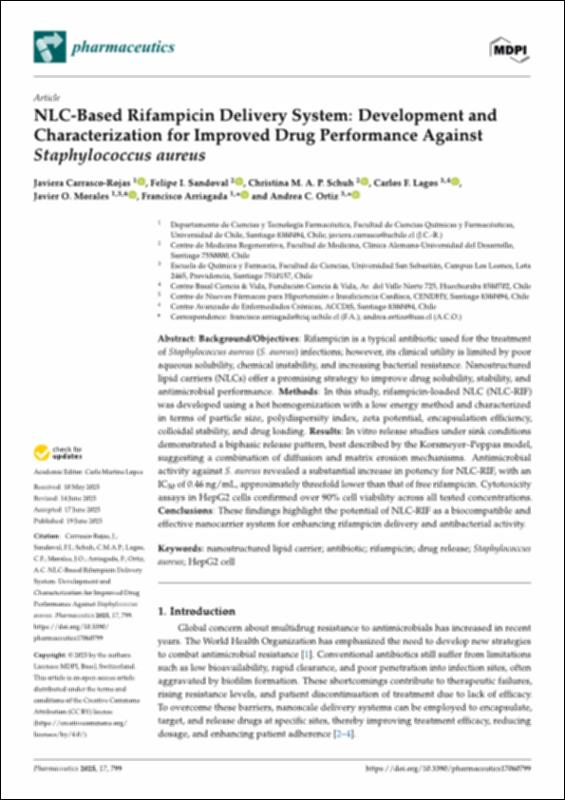
Background/Objectives: Rifampicin is a typical antibiotic used for the treatment of Staphylococcus aureus (S. aureus) infections; however, its clinical utility is limited by poor aqueous solubility, chemical instability, and increasing bacterial resistance. Nanostructured lipid carriers (NLCs) offer a promising strategy to improve drug solubility, stability, and antimicrobial performance. Methods: In this study, rifampicin-loaded NLC (NLC-RIF) was developed using a hot homogenization with a low energy method and characterized in terms of particle size, polydispersity index, zeta potential, encapsulation efficiency, colloidal stability, and drug loading. Results: In vitro release studies under sink conditions demonstrated a biphasic release pattern, best described by the Korsmeyer–Peppas model, suggesting a combination of diffusion and matrix erosion mechanisms. Antimicrobial activity against S. aureus revealed a substantial increase in potency for NLC-RIF, with an IC50 of 0.46 ng/mL, approximately threefold lower than that of free rifampicin. Cytotoxicity assays in HepG2 cells confirmed over 90% cell viability across all tested concentrations. Conclusions: These findings highlight the potential of NLC-RIF as a biocompatible and effective nanocarrier system for enhancing rifampicin delivery and antibacterial activity. |
Este ítem aparece en la(s) siguiente(s) colección(ones)
-
Acceso Abierto USS [3006]