

- Inicio
- >
- Institucional
- >
- Acceso Abierto USS
- >
- Ver ítem
JavaScript is disabled for your browser. Some features of this site may not work without it.
Descubre información por...
Buscar documentos por...
Mostrar el registro sencillo del ítem
| dc.contributor.author | Aburto, C. | |
| dc.contributor.author | Ruminot, I. | |
| dc.contributor.author | San Martín, A. | |
| dc.date.accessioned | 2026-02-08T03:32:02Z | |
| dc.date.available | 2026-02-08T03:32:02Z | |
| dc.date.issued | 2025-09 | |
| dc.identifier.issn | 2213-2317 | |
| dc.identifier.other | Mendeley: ec941c3e-8a79-35d3-a431-c05af2a60218 | |
| dc.identifier.uri | https://repositorio.uss.cl/handle/uss/20591 | |
| dc.description | Publisher Copyright: © 2025 | |
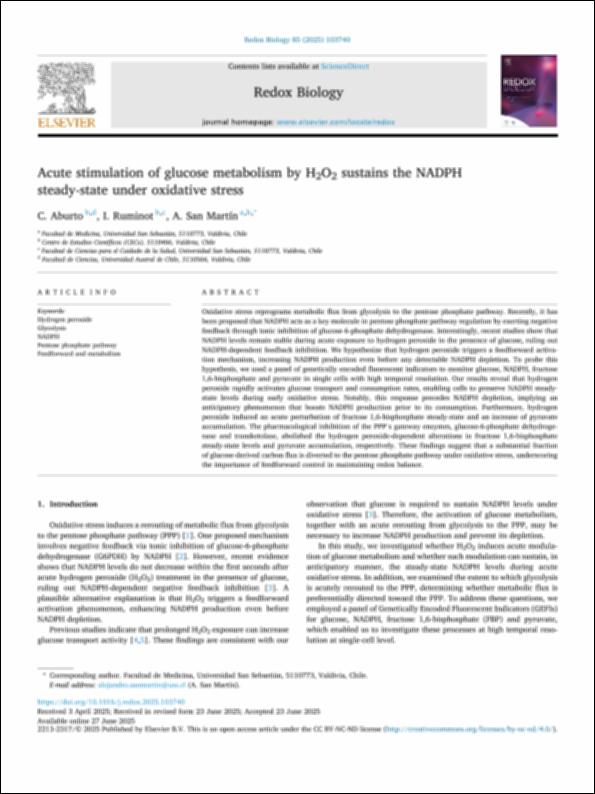
| dc.description.abstract | Oxidative stress reprograms metabolic flux from glycolysis to the pentose phosphate pathway. Recently, it has been proposed that NADPH acts as a key molecule in pentose phosphate pathway regulation by exerting negative feedback through tonic inhibition of glucose-6-phosphate dehydrogenase. Interestingly, recent studies show that NADPH levels remain stable during acute exposure to hydrogen peroxide in the presence of glucose, ruling out NADPH-dependent feedback inhibition. We hypothesize that hydrogen peroxide triggers a feedforward activation mechanism, increasing NADPH production even before any detectable NADPH depletion. To probe this hypothesis, we used a panel of genetically encoded fluorescent indicators to monitor glucose, NADPH, fructose 1,6-bisphosphate and pyruvate in single cells with high temporal resolution. Our results reveal that hydrogen peroxide rapidly activates glucose transport and consumption rates, enabling cells to preserve NADPH steady-state levels during early oxidative stress. Notably, this response precedes NADPH depletion, implying an anticipatory phenomenon that boosts NADPH production prior to its consumption. Furthermore, hydrogen peroxide induced an acute perturbation of fructose 1,6-bisphosphate steady-state and an increase of pyruvate accumulation. The pharmacological inhibition of the PPP's gateway enzymes, glucose-6-phosphate dehydrogenase and transketolase, abolished the hydrogen peroxide-dependent alterations in fructose 1,6-bisphosphate steady-state levels and pyruvate accumulation, respectively. These findings suggest that a substantial fraction of glucose-derived carbon flux is diverted to the pentose phosphate pathway under oxidative stress, underscoring the importance of feedforward control in maintaining redox balance. | en |
| dc.language.iso | eng | |
| dc.relation.ispartof | vol. 85 Issue: Pages: | |
| dc.source | Redox Biology | |
| dc.title | Acute stimulation of glucose metabolism by H2O2 sustains the NADPH steady-state under oxidative stress | en |
| dc.type | Artículo | |
| dc.identifier.doi | 10.1016/j.redox.2025.103740 | |
| dc.publisher.department | Facultad de Ciencias de la Rehabilitación y Calidad de Vida | |
| dc.publisher.department | Facultad de Medicina |
Este ítem aparece en la(s) siguiente(s) colección(ones)
-
Acceso Abierto USS [3006]