

- Inicio
- >
- Institucional
- >
- Acceso Abierto USS
- >
- Ver ítem
JavaScript is disabled for your browser. Some features of this site may not work without it.
Descubre información por...
Buscar documentos por...

Temporalmente, el archivo digital asociado a esta publicación, no se encuentra disponible. Para más información escribir a [email protected]
Este documento se encuentra disponible en su fuente de origen, si desea acceder al texto completo, puedes hacerlo a continuación:
Association Between Lifestyle Parameters, Quality of Life, and Satisfaction with Life in Chilean University Students : Asociación entre parámetros del estilo de vida, calidad de vida y satisfacción con la vida en estudiantes universitarios chilenos
|
Autor(es)
Caamaño-Navarrete, Felipe; Arriagada-Hernández, Carlos; Fuentes, Gerardo; Guzmán Guzmán, Iris Paola; Jara-Tomckowiack, Lorena; Jerez, Daniel; Del-Cuerpo, Indya; Contreras Díaz, Guido Edgardo; Hernández Mosqueira, Claudio; Vargas, Claudia Andrea; Delgado Floody, Pedro |
|
ISSN:
2227-9032 |
|
Idioma:
eng |
|
Fecha:
2025-08-09 |
|
Tipo:
Artículo |
|
Revista:
Healthcare (Switzerland) |
|
DOI:
10.3390/healthcare13161950 |
|
Resumen:
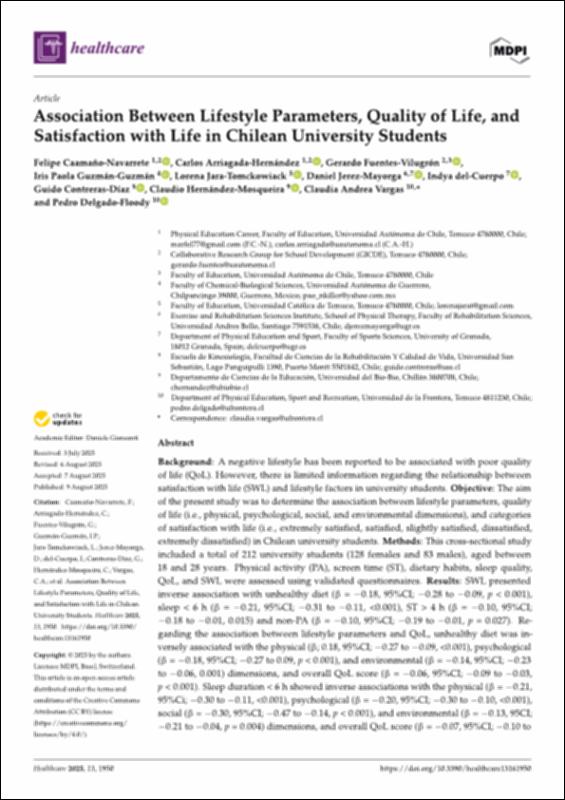
Background: A negative lifestyle has been reported to be associated with poor quality of life (QoL). However, there is limited information regarding the relationship between satisfaction with life (SWL) and lifestyle factors in university students. Objective: The aim of the present study was to determine the association between lifestyle parameters, quality of life (i.e., physical, psychological, social, and environmental dimensions), and categories of satisfaction with life (i.e., extremely satisfied, satisfied, slightly satisfied, dissatisfied, extremely dissatisfied) in Chilean university students. Methods: This cross-sectional study included a total of 212 university students (128 females and 83 males), aged between 18 and 28 years. Physical activity (PA), screen time (ST), dietary habits, sleep quality, QoL, and SWL were assessed using validated questionnaires. Results: SWL presented inverse association with unhealthy diet (β=−0.18, 95%CI −0.28 to−0.09, p < 0.001), sleep < 6 h (β=−0.21, 95%CI;−0.31 to−0.11, <0.001), ST > 4 h (β=−0.10, 95%CI; −0.18 to−0.01, 0.015) and non-PA (β=−0.10, 95%CI;−0.19 to−0.01, p = 0.027). Regarding the association between lifestyle parameters and QoL, unhealthy diet was inversely associated with the physical (β; 0.18, 95%CI;−0.27 to−0.09, <0.001), psychological (β=−0.18, 95%CI;−0.27 to 0.09, p < 0.001), and environmental (β=−0.14, 95%CI;−0.23 to−0.06, 0.001) dimensions, and overall QoL score (β=−0.06, 95%CI;−0.09 to−0.03, p < 0.001). Sleep duration < 6 h showed inverse associations with the physical (β=−0.21, 95%Ci;−0.30 to−0.11, <0.001), psychological (β=−0.20, 95%CI;−0.30 to−0.10, <0.001), social (β=−0.30, 95%CI;−0.47 to−0.14, p < 0.001), and environmental (β=−0.13, 95CI; −0.21 to−0.04, p = 0.004) dimensions, and overall QoL score (β=−0.07, 95%CI;−0.10 to −0.04, p < 0.001). Non PA was associated with physical dimensions (β=−0.09, 95%CI; −0.17 to−0.01, p = 0.019). Non-PA reported association with physical (β=−0.16, 95%CI; −0.25 to−0.07, p < 0.001), psychological (β=−0.20, 95%CI;−0.30 to−0.10, p < 0.001), social (β=−0.25, 95%CI;−0.41 to−0.09, p = 0.002), and environmental (β=−0.11, 95%CI; −0.19 to−0.02, p = 0.010) dimensions, and QoL overall score (β=−0.06, 95%CI;−0.09 to −0.03, p < 0.001). Conclusions: Poor diet, inadequate sleep, excessive ST, and non-PA are all associated with negative impacts on SWL and QoL in Chilean university students. |
Este ítem aparece en la(s) siguiente(s) colección(ones)
-
Acceso Abierto USS [3006]