

- Inicio
- >
- Institucional
- >
- Acceso Abierto USS
- >
- Ver ítem
JavaScript is disabled for your browser. Some features of this site may not work without it.
Descubre información por...
Buscar documentos por...
Mostrar el registro sencillo del ítem
| dc.contributor.author | Pacheco-Acosta, Sebastián | |
| dc.contributor.author | Castro-Toro, Gustavo | |
| dc.contributor.author | Rojas-Villalobos, Camila | |
| dc.contributor.author | Valenzuela, Cesar | |
| dc.contributor.author | Haristoy, Juan José | |
| dc.contributor.author | Zapata-Araya, Abraham | |
| dc.contributor.author | Moya-Beltrán, Ana | |
| dc.contributor.author | Sepúlveda-Rebolledo, Pedro | |
| dc.contributor.author | Pérez-Rueda, Ernesto | |
| dc.contributor.author | Ulloa, Ricardo | |
| dc.contributor.author | Giaveno, Alejandra | |
| dc.contributor.author | Issotta, Francisco | |
| dc.contributor.author | Díez, Beatriz | |
| dc.contributor.author | Beard, Simón | |
| dc.contributor.author | Quatrini, Raquel | |
| dc.date.accessioned | 2026-02-08T03:34:07Z | |
| dc.date.available | 2026-02-08T03:34:07Z | |
| dc.date.issued | 2025 | |
| dc.identifier.issn | 1664-302X | |
| dc.identifier.uri | https://repositorio.uss.cl/handle/uss/20693 | |
| dc.description | Publisher Copyright: Copyright © 2025 Pacheco-Acosta, Castro-Toro, Rojas-Villalobos, Valenzuela, Haristoy, Zapata-Araya, Moya-Beltrán, Sepúlveda-Rebolledo, Pérez-Rueda, Ulloa, Giaveno, Issotta, Díez, Beard and Quatrini. | |
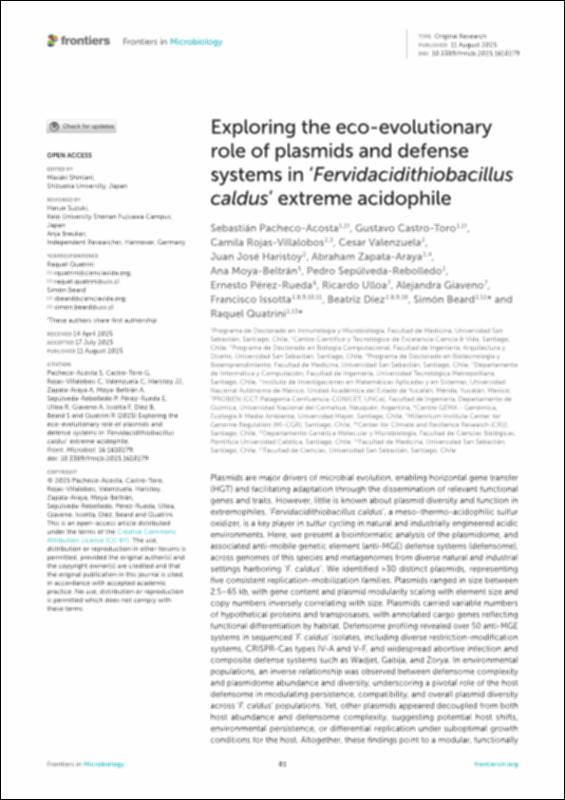
| dc.description.abstract | Plasmids are major drivers of microbial evolution, enabling horizontal gene transfer (HGT) and facilitating adaptation through the dissemination of relevant functional genes and traits. However, little is known about plasmid diversity and function in extremophiles. ‘Fervidacidithiobacillus caldus’, a meso-thermo-acidophilic sulfur oxidizer, is a key player in sulfur cycling in natural and industrially engineered acidic environments. Here, we present a bioinformatic analysis of the plasmidome, and associated anti-mobile genetic element (anti-MGE) defense systems (defensome), across genomes of this species and metagenomes from diverse natural and industrial settings harboring ‘F. caldus’. We identified >30 distinct plasmids, representing five consistent replication-mobilization families. Plasmids ranged in size between 2.5–65 kb, with gene content and plasmid modularity scaling with element size and copy numbers inversely correlating with size. Plasmids carried variable numbers of hypothetical proteins and transposases, with annotated cargo genes reflecting functional differentiation by habitat. Defensome profiling revealed over 50 anti-MGE systems in sequenced ‘F. caldus’ isolates, including diverse restriction-modification systems, CRISPR-Cas types IV-A and V-F, and widespread abortive infection and composite defense systems such as Wadjet, Gabija, and Zorya. In environmental populations, an inverse relationship was observed between defensome complexity and plasmidome abundance and diversity, underscoring a pivotal role of the host defensome in modulating persistence, compatibility, and overall plasmid diversity across ‘F. caldus’ populations. Yet, other plasmids appeared decoupled from both host abundance and defensome complexity, suggesting potential host shifts, environmental persistence, or differential replication under suboptimal growth conditions for the host. Altogether, these findings point to a modular, functionally diverse adaptive plasmidome shaped by environmental pressures, by the interplay with the host’s defensome, and likely also by other eco-evolutionary processes at play in natural environments. While these associations are compelling, causal relationships remain to be experimentally validated. These insights broaden our understanding of mobile genetic elements in extreme environments and provide a foundation for plasmid-based vector design and synthetic biology applications in acidophiles, with direct implications to biomining and environmental remediation. | en |
| dc.language.iso | eng | |
| dc.relation.ispartof | vol. 16 Issue: Pages: | |
| dc.source | Frontiers in Microbiology | |
| dc.title | Exploring the eco-evolutionary role of plasmids and defense systems in ‘Fervidacidithiobacillus caldus’ extreme acidophile | en |
| dc.type | Artículo | |
| dc.identifier.doi | 10.3389/fmicb.2025.1610279 | |
| dc.publisher.department | Facultad de Medicina | |
| dc.publisher.department | Facultad de Ingeniería | |
| dc.publisher.department | Facultad de Ciencias |
Este ítem aparece en la(s) siguiente(s) colección(ones)
-
Acceso Abierto USS [3006]