

- Inicio
- >
- Institucional
- >
- Acceso Abierto USS
- >
- Ver ítem
JavaScript is disabled for your browser. Some features of this site may not work without it.
Descubre información por...
Buscar documentos por...
Mostrar el registro sencillo del ítem
| dc.contributor.author | Muñoz-Gómez, Marcia | |
| dc.contributor.author | Fanning, Mark | |
| dc.contributor.author | Tapia, Felipe | |
| dc.contributor.author | Payacán Payacán, Ítalo Joaquín | |
| dc.contributor.author | Fuentes, Francisco | |
| dc.contributor.author | Farías, Marcelo | |
| dc.contributor.author | Charrier, Reynaldo | |
| dc.contributor.author | Polvé, Mireille | |
| dc.contributor.author | Quiñones, Sergio | |
| dc.contributor.author | Deckart, Katja | |
| dc.contributor.author | Fock, Andrés | |
| dc.date.accessioned | 2026-02-08T03:34:33Z | |
| dc.date.available | 2026-02-08T03:34:33Z | |
| dc.date.issued | 2025-09 | |
| dc.identifier.issn | 1525-2027 | |
| dc.identifier.uri | https://repositorio.uss.cl/handle/uss/20712 | |
| dc.description | Publisher Copyright: © 2025 The Author(s). Geochemistry, Geophysics, Geosystems published by Wiley Periodicals LLC on behalf of American Geophysical Union. | |
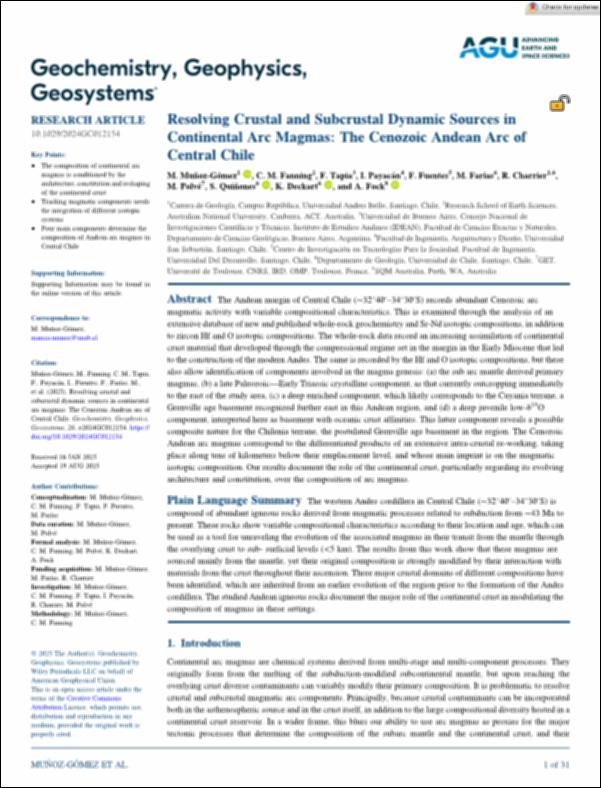
| dc.description.abstract | The Andean margin of Central Chile (∼32°40′–34°30′S) records abundant Cenozoic arc magmatic activity with variable compositional characteristics. This is examined through the analysis of an extensive database of new and published whole-rock geochemistry and Sr-Nd isotopic compositions, in addition to zircon Hf and O isotopic compositions. The whole-rock data record an increasing assimilation of continental crust material that developed through the compressional regime set in the margin in the Early Miocene that led to the construction of the modern Andes. The same is recorded by the Hf and O isotopic compositions, but these also allow identification of components involved in the magma genesis: (a) the sub arc mantle derived primary magmas, (b) a late Paleozoic—Early Triassic crystalline component, as that currently outcropping immediately to the east of the study area, (c) a deep enriched component, which likely corresponds to the Cuyania terrane, a Grenville age basement recognized further east in this Andean region, and (d) a deep juvenile low-δ18O component, interpreted here as basement with oceanic crust affinities. This latter component reveals a possible composite nature for the Chilenia terrane, the postulated Grenville age basement in the region. The Cenozoic Andean arc magmas correspond to the differentiated products of an extensive intra-crustal re-working, taking place along tens of kilometers below their emplacement level, and whose main imprint is on the magmatic isotopic composition. Our results document the role of the continental crust, particularly regarding its evolving architecture and constitution, over the composition of arc magmas. | en |
| dc.language.iso | eng | |
| dc.relation.ispartof | vol. 26 Issue: no. 9 Pages: 1 | |
| dc.source | Geochemistry, Geophysics, Geosystems | |
| dc.title | Resolving Crustal and Subcrustal Dynamic Sources in Continental Arc Magmas: The Cenozoic Andean Arc of Central Chile | en |
| dc.type | Artículo | |
| dc.identifier.doi | 10.1029/2024GC012154 | |
| dc.publisher.department | Facultad de Ingeniería |
Este ítem aparece en la(s) siguiente(s) colección(ones)
-
Acceso Abierto USS [3006]