

- Inicio
- >
- Institucional
- >
- Acceso Abierto USS
- >
- Ver ítem
JavaScript is disabled for your browser. Some features of this site may not work without it.
Descubre información por...
Buscar documentos por...

Temporalmente, el archivo digital asociado a esta publicación, no se encuentra disponible. Para más información escribir a [email protected]
Este documento se encuentra disponible en su fuente de origen, si desea acceder al texto completo, puedes hacerlo a continuación:
APOE genotype-dependent differences in human astrocytic energy metabolism
|
Autor(es)
Budny, Vanessa; Bodenmann, Chantal; Zürcher, Kathrin J.; Krüger, Maik; de Leeuw, Sherida M.; Weber, Rebecca Z.; Rust, Ruslan; Ravotto, Luca; Ruminot, Iván; Barros, L. Felipe; Weber, Bruno; Tackenberg, Christian |
|
ISSN:
1662-5102 |
|
Idioma:
eng |
|
Fecha:
2025 |
|
Tipo:
Artículo |
|
Revista:
Frontiers in Cellular Neuroscience |
|
Datos de la publicación:
vol. 19 Issue: Pages: |
|
DOI:
10.3389/fncel.2025.1603657 |
|
Descripción:
Publisher Copyright: Copyright © 2025 Budny, Bodenmann, Zürcher, Krüger, de Leeuw, Weber, Rust, Ravotto, Ruminot, Barros, Weber and Tackenberg. |
|
Resumen:
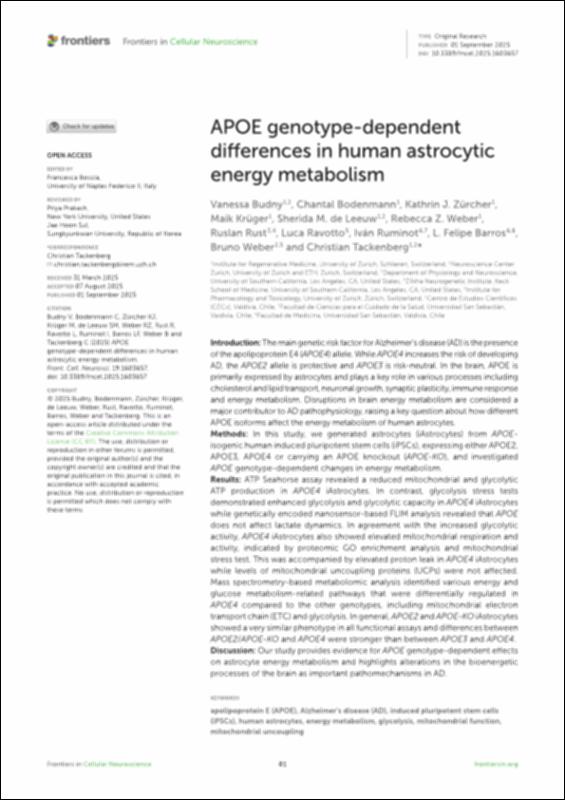
Introduction: The main genetic risk factor for Alzheimer’s disease (AD) is the presence of the apolipoprotein E4 (APOE4) allele. While APOE4 increases the risk of developing AD, the APOE2 allele is protective and APOE3 is risk-neutral. In the brain, APOE is primarily expressed by astrocytes and plays a key role in various processes including cholesterol and lipid transport, neuronal growth, synaptic plasticity, immune response and energy metabolism. Disruptions in brain energy metabolism are considered a major contributor to AD pathophysiology, raising a key question about how different APOE isoforms affect the energy metabolism of human astrocytes. Methods: In this study, we generated astrocytes (iAstrocytes) from APOE-isogenic human induced pluripotent stem cells (iPSCs), expressing either APOE2, APOE3, APOE4 or carrying an APOE knockout (APOE-KO), and investigated APOE genotype-dependent changes in energy metabolism. Results: ATP Seahorse assay revealed a reduced mitochondrial and glycolytic ATP production in APOE4 iAstrocytes. In contrast, glycolysis stress tests demonstrated enhanced glycolysis and glycolytic capacity in APOE4 iAstrocytes while genetically encoded nanosensor-based FLIM analysis revealed that APOE does not affect lactate dynamics. In agreement with the increased glycolytic activity, APOE4 iAstrocytes also showed elevated mitochondrial respiration and activity, indicated by proteomic GO enrichment analysis and mitochondrial stress test. This was accompanied by elevated proton leak in APOE4 iAstrocytes while levels of mitochondrial uncoupling proteins (UCPs) were not affected. Mass spectrometry-based metabolomic analysis identified various energy and glucose metabolism-related pathways that were differentially regulated in APOE4 compared to the other genotypes, including mitochondrial electron transport chain (ETC) and glycolysis. In general, APOE2 and APOE-KO iAstrocytes showed a very similar phenotype in all functional assays and differences between APOE2/APOE-KO and APOE4 were stronger than between APOE3 and APOE4. Discussion: Our study provides evidence for APOE genotype-dependent effects on astrocyte energy metabolism and highlights alterations in the bioenergetic processes of the brain as important pathomechanisms in AD. |
Este ítem aparece en la(s) siguiente(s) colección(ones)
-
Acceso Abierto USS [3006]