

- Inicio
- >
- Institucional
- >
- Acceso Abierto USS
- >
- Ver ítem
JavaScript is disabled for your browser. Some features of this site may not work without it.
Descubre información por...
Buscar documentos por...
Mostrar el registro sencillo del ítem
| dc.contributor.author | Cartes Velásquez, Ricardo Andrés | |
| dc.contributor.author | Morales-León, Felipe | |
| dc.contributor.author | Valdebenito-Maturana, Franco | |
| dc.contributor.author | Saéz-Riquelme, Pablo | |
| dc.contributor.author | Rodríguez-Ortiz, Nicolás | |
| dc.contributor.author | Carrillo-Bestagno, Hernán | |
| dc.date.accessioned | 2026-02-08T03:35:10Z | |
| dc.date.available | 2026-02-08T03:35:10Z | |
| dc.date.issued | 2025-06-23 | |
| dc.identifier.issn | 2673-401X | |
| dc.identifier.uri | https://repositorio.uss.cl/handle/uss/20752 | |
| dc.description | Publisher Copyright: © 2025 by the authors. | |
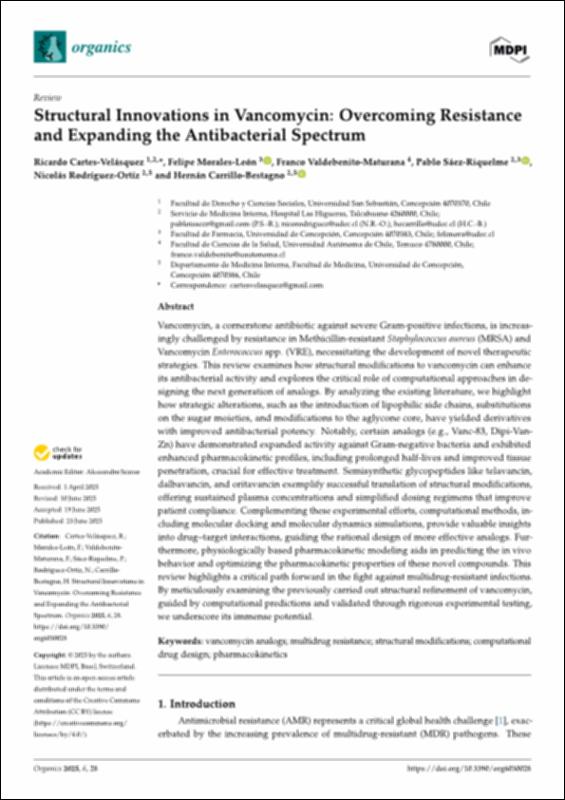
| dc.description.abstract | Vancomycin, a cornerstone antibiotic against severe Gram-positive infections, is increasingly challenged by resistance in Methicillin-resistant Staphylococcus aureus (MRSA) and Vancomycin Enterococcus spp. (VRE), necessitating the development of novel therapeutic strategies. This review examines how structural modifications to vancomycin can enhance its antibacterial activity and explores the critical role of computational approaches in designing the next generation of analogs. By analyzing the existing literature, we highlight how strategic alterations, such as the introduction of lipophilic side chains, substitutions on the sugar moieties, and modifications to the aglycone core, have yielded derivatives with improved antibacterial potency. Notably, certain analogs (e.g., Vanc-83, Dipi-Van-Zn) have demonstrated expanded activity against Gram-negative bacteria and exhibited enhanced pharmacokinetic profiles, including prolonged half-lives and improved tissue penetration, crucial for effective treatment. Semisynthetic glycopeptides like telavancin, dalbavancin, and oritavancin exemplify successful translation of structural modifications, offering sustained plasma concentrations and simplified dosing regimens that improve patient compliance. Complementing these experimental efforts, computational methods, including molecular docking and molecular dynamics simulations, provide valuable insights into drug–target interactions, guiding the rational design of more effective analogs. Furthermore, physiologically based pharmacokinetic modeling aids in predicting the in vivo behavior and optimizing the pharmacokinetic properties of these novel compounds. This review highlights a critical path forward in the fight against multidrug-resistant infections. By meticulously examining the previously carried out structural refinement of vancomycin, guided by computational predictions and validated through rigorous experimental testing, we underscore its immense potential. | es |
| dc.language.iso | eng | |
| dc.relation.ispartof | vol. 6 Issue: no. 3 Pages: 1-16 | |
| dc.source | Organics | |
| dc.title | Structural Innovations in Vancomycin : Overcoming Resistance and Expanding the Antibacterial Spectrum | en |
| dc.type | Artículo de revisión | |
| dc.identifier.doi | 10.3390/org6030028 | |
| dc.publisher.department | Facultad de Derecho y Ciencias Sociales |
Este ítem aparece en la(s) siguiente(s) colección(ones)
-
Acceso Abierto USS [3006]