

- Inicio
- >
- Institucional
- >
- Acceso Abierto USS
- >
- Ver ítem
JavaScript is disabled for your browser. Some features of this site may not work without it.
Descubre información por...
Buscar documentos por...
Mostrar el registro sencillo del ítem
| dc.contributor.author | Crespo, Francisco | |
| dc.contributor.author | Vidarte, Jhon | |
| dc.contributor.author | Villafañe, Jersson | |
| dc.contributor.author | Zapata Hernández, Jorge Luis | |
| dc.date.accessioned | 2026-02-08T03:35:32Z | |
| dc.date.available | 2026-02-08T03:35:32Z | |
| dc.date.issued | 2025 | |
| dc.identifier.issn | 2073-8994 | |
| dc.identifier.uri | https://repositorio.uss.cl/handle/uss/20768 | |
| dc.description | Publisher Copyright: © 2025 by the authors. | |
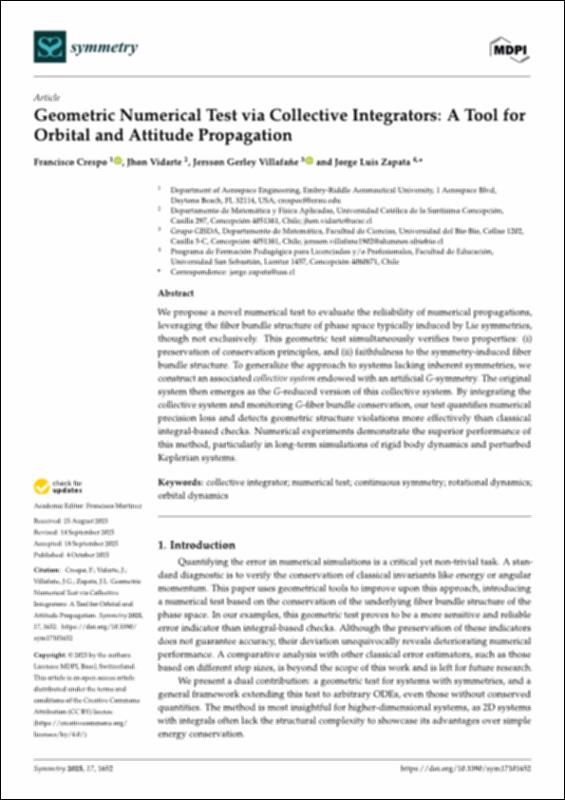
| dc.description.abstract | We propose a novel numerical test to evaluate the reliability of numerical propagations, leveraging the fiber bundle structure of phase space typically induced by Lie symmetries, though not exclusively. This geometric test simultaneously verifies two properties: (i) preservation of conservation principles, and (ii) faithfulness to the symmetry-induced fiber bundle structure. To generalize the approach to systems lacking inherent symmetries, we construct an associated collective system endowed with an artificial G-symmetry. The original system then emerges as the G-reduced version of this collective system. By integrating the collective system and monitoring G-fiber bundle conservation, our test quantifies numerical precision loss and detects geometric structure violations more effectively than classical integral-based checks. Numerical experiments demonstrate the superior performance of this method, particularly in long-term simulations of rigid body dynamics and perturbed Keplerian systems. | en |
| dc.language.iso | eng | |
| dc.relation.ispartof | vol. 17 Issue: no. 10 Pages: | |
| dc.source | Symmetry | |
| dc.title | Geometric Numerical Test via Collective Integrators : A Tool for Orbital and Attitude Propagation | en |
| dc.type | Artículo | |
| dc.identifier.doi | 10.3390/sym17101652 | |
| dc.publisher.department | Facultad de Educación |
Este ítem aparece en la(s) siguiente(s) colección(ones)
-
Acceso Abierto USS [3006]