

- Inicio
- >
- Institucional
- >
- Acceso Abierto USS
- >
- Ver ítem
JavaScript is disabled for your browser. Some features of this site may not work without it.
Descubre información por...
Buscar documentos por...
Mostrar el registro sencillo del ítem
| dc.contributor.author | Pradena Miquel, Mauricio Alejandro | |
| dc.contributor.author | Fuentealba, Cecilia | |
| dc.contributor.author | Schwarz, Alex | |
| dc.contributor.author | Escribano, Daniella | |
| dc.contributor.author | Avila-Vidal, Nicole | |
| dc.date.accessioned | 2026-02-08T03:35:44Z | |
| dc.date.available | 2026-02-08T03:35:44Z | |
| dc.date.issued | 2025-10 | |
| dc.identifier.issn | 2075-5309 | |
| dc.identifier.other | Mendeley: ac0e17f5-3bb2-341a-b321-8c1fa4de319a | |
| dc.identifier.uri | https://repositorio.uss.cl/handle/uss/20778 | |
| dc.description | Publisher Copyright: © 2025 by the authors. | |
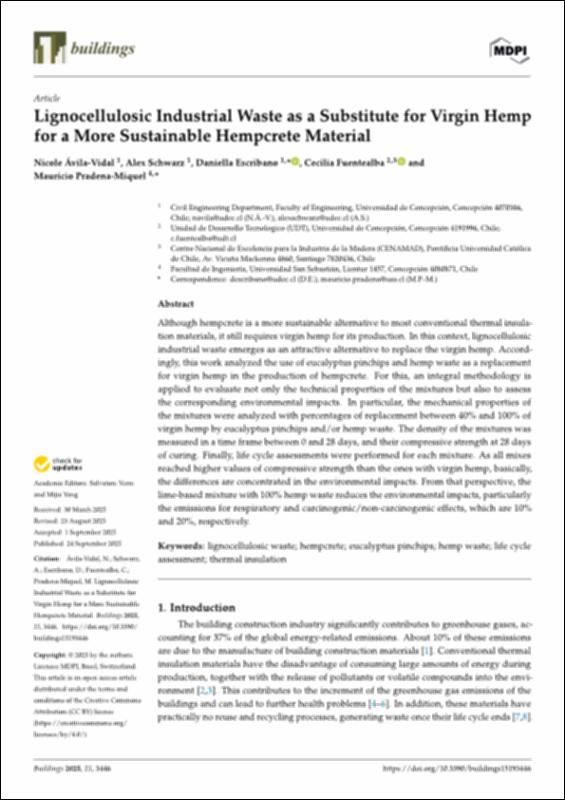
| dc.description.abstract | Although hempcrete is a more sustainable alternative to most conventional thermal insulation materials, it still requires virgin hemp for its production. In this context, lignocellulosic industrial waste emerges as an attractive alternative to replace the virgin hemp. Accordingly, this work analyzed the use of eucalyptus pinchips and hemp waste as a replacement for virgin hemp in the production of hempcrete. For this, an integral methodology is applied to evaluate not only the technical properties of the mixtures but also to assess the corresponding environmental impacts. In particular, the mechanical properties of the mixtures were analyzed with percentages of replacement between 40% and 100% of virgin hemp by eucalyptus pinchips and/or hemp waste. The density of the mixtures was measured in a time frame between 0 and 28 days, and their compressive strength at 28 days of curing. Finally, life cycle assessments were performed for each mixture. As all mixes reached higher values of compressive strength than the ones with virgin hemp, basically, the differences are concentrated in the environmental impacts. From that perspective, the lime-based mixture with 100% hemp waste reduces the environmental impacts, particularly the emissions for respiratory and carcinogenic/non-carcinogenic effects, which are 10% and 20%, respectively. | es |
| dc.language.iso | eng | |
| dc.relation.ispartof | vol. 15 Issue: no. 19 Pages: 3446 | |
| dc.source | Buildings | |
| dc.title | Lignocellulosic Industrial Waste as a Substitute for Virgin Hemp for a More Sustainable Hempcrete Material | en |
| dc.type | Artículo | |
| dc.identifier.doi | 10.3390/buildings15193446 | |
| dc.publisher.department | Facultad de Ingeniería |
Este ítem aparece en la(s) siguiente(s) colección(ones)
-
Acceso Abierto USS [3006]