

- Inicio
- >
- Institucional
- >
- Acceso Abierto USS
- >
- Ver ítem
JavaScript is disabled for your browser. Some features of this site may not work without it.
Descubre información por...
Buscar documentos por...
Mostrar el registro sencillo del ítem
| dc.contributor.author | Baesler Abufarde, Felipe Fabián | |
| dc.contributor.author | Cornejo, Oscar | |
| dc.contributor.author | Obreque, Carlos | |
| dc.contributor.author | Forcael Durán, Eric Fabián | |
| dc.contributor.author | Carrasco Vidal, Rudy | |
| dc.date.accessioned | 2026-02-08T03:35:58Z | |
| dc.date.available | 2026-02-08T03:35:58Z | |
| dc.date.issued | 2025-10 | |
| dc.identifier.issn | 2079-8954 | |
| dc.identifier.uri | https://repositorio.uss.cl/handle/uss/20793 | |
| dc.description | Publisher Copyright: © 2025 by the authors. | |
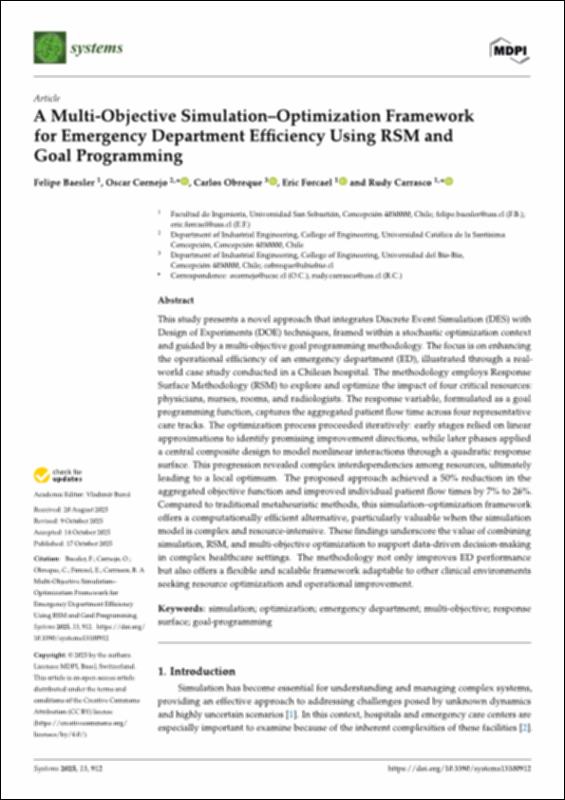
| dc.description.abstract | This study presents a novel approach that integrates Discrete Event Simulation (DES) with Design of Experiments (DOE) techniques, framed within a stochastic optimization context and guided by a multi-objective goal programming methodology. The focus is on enhancing the operational efficiency of an emergency department (ED), illustrated through a real-world case study conducted in a Chilean hospital. The methodology employs Response Surface Methodology (RSM) to explore and optimize the impact of four critical resources: physicians, nurses, rooms, and radiologists. The response variable, formulated as a goal programming function, captures the aggregated patient flow time across four representative care tracks. The optimization process proceeded iteratively: early stages relied on linear approximations to identify promising improvement directions, while later phases applied a central composite design to model nonlinear interactions through a quadratic response surface. This progression revealed complex interdependencies among resources, ultimately leading to a local optimum. The proposed approach achieved a 50% reduction in the aggregated objective function and improved individual patient flow times by 7% to 26%. Compared to traditional metaheuristic methods, this simulation–optimization framework offers a computationally efficient alternative, particularly valuable when the simulation model is complex and resource-intensive. These findings underscore the value of combining simulation, RSM, and multi-objective optimization to support data-driven decision-making in complex healthcare settings. The methodology not only improves ED performance but also offers a flexible and scalable framework adaptable to other clinical environments seeking resource optimization and operational improvement. | en |
| dc.language.iso | eng | |
| dc.relation.ispartof | vol. 13 Issue: no. 10 Pages: | |
| dc.source | Systems | |
| dc.title | A Multi-Objective Simulation–Optimization Framework for Emergency Department Efficiency Using RSM and Goal Programming | en |
| dc.type | Artículo | |
| dc.identifier.doi | 10.3390/systems13100912 | |
| dc.publisher.department | Facultad de Ingeniería |
Este ítem aparece en la(s) siguiente(s) colección(ones)
-
Acceso Abierto USS [3006]