

- Inicio
- >
- Institucional
- >
- Acceso Abierto USS
- >
- Ver ítem
JavaScript is disabled for your browser. Some features of this site may not work without it.
Descubre información por...
Buscar documentos por...
Mostrar el registro sencillo del ítem
| dc.contributor.author | Triantafyllou, George | |
| dc.contributor.author | Paschopoulos, Ioannis | |
| dc.contributor.author | Kamoutsis, Katerina | |
| dc.contributor.author | Papadopoulos-Manolarakis, Panagiotis | |
| dc.contributor.author | Fuenzalida, Juan José Valenzuela | |
| dc.contributor.author | Sanchis-Gimeno, Juan A. | |
| dc.contributor.author | Bruna-Mejias, Alejandro | |
| dc.contributor.author | Riveros Valdés, Andrés Sebastián | |
| dc.contributor.author | Arkoudis, Nikolaos-Achilleas | |
| dc.contributor.author | Samolis, Alexandros | |
| dc.contributor.author | Tsakotos, George | |
| dc.contributor.author | Piagkou, Maria | |
| dc.date.accessioned | 2026-02-08T03:36:06Z | |
| dc.date.available | 2026-02-08T03:36:06Z | |
| dc.date.issued | 2025-08 | |
| dc.identifier.issn | 2075-4418 | |
| dc.identifier.uri | https://repositorio.uss.cl/handle/uss/20798 | |
| dc.description | Publisher Copyright: © 2025 by the authors. | |
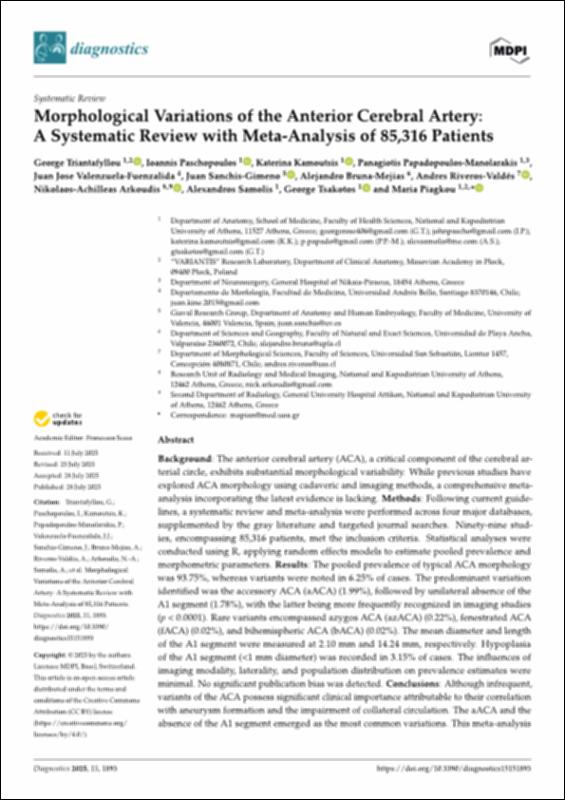
| dc.description.abstract | Background: The anterior cerebral artery (ACA), a critical component of the cerebral arterial circle, exhibits substantial morphological variability. While previous studies have explored ACA morphology using cadaveric and imaging methods, a comprehensive meta-analysis incorporating the latest evidence is lacking. Methods: Following current guidelines, a systematic review and meta-analysis were performed across four major databases, supplemented by the gray literature and targeted journal searches. Ninety-nine studies, encompassing 85,316 patients, met the inclusion criteria. Statistical analyses were conducted using R, applying random effects models to estimate pooled prevalence and morphometric parameters. Results: The pooled prevalence of typical ACA morphology was 93.75%, whereas variants were noted in 6.25% of cases. The predominant variation identified was the accessory ACA (aACA) (1.99%), followed by unilateral absence of the A1 segment (1.78%), with the latter being more frequently recognized in imaging studies (p < 0.0001). Rare variants encompassed azygos ACA (azACA) (0.22%), fenestrated ACA (fACA) (0.02%), and bihemispheric ACA (bACA) (0.02%). The mean diameter and length of the A1 segment were measured at 2.10 mm and 14.24 mm, respectively. Hypoplasia of the A1 segment (<1 mm diameter) was recorded in 3.15% of cases. The influences of imaging modality, laterality, and population distribution on prevalence estimates were minimal. No significant publication bias was detected. Conclusions: Although infrequent, variants of the ACA possess significant clinical importance attributable to their correlation with aneurysm formation and the impairment of collateral circulation. The aACA and the absence of the A1 segment emerged as the most common variations. This meta-analysis presents an updated and high-quality synthesis of ACA morphology, serving as a valuable reference for clinicians and anatomists. | en |
| dc.description.abstract | Background: The anterior cerebral artery (ACA), a critical component of the cerebral arterial circle, exhibits substantial morphological variability. While previous studies have explored ACA morphology using cadaveric and imaging methods, a comprehensive meta-analysis incorporating the latest evidence is lacking. Methods: Following current guidelines, a systematic review and meta-analysis were performed across four major databases, supplemented by the gray literature and targeted journal searches. Ninety-nine studies, encompassing 85,316 patients, met the inclusion criteria. Statistical analyses were conducted using R, applying random effects models to estimate pooled prevalence and morphometric parameters. Results: The pooled prevalence of typical ACA morphology was 93.75%, whereas variants were noted in 6.25% of cases. The predominant variation identified was the accessory ACA (aACA) (1.99%), followed by unilateral absence of the A1 segment (1.78%), with the latter being more frequently recognized in imaging studies (p < 0.0001). Rare variants encompassed azygos ACA (azACA) (0.22%), fenestrated ACA (fACA) (0.02%), and bihemispheric ACA (bACA) (0.02%). The mean diameter and length of the A1 segment were measured at 2.10 mm and 14.24 mm, respectively. Hypoplasia of the A1 segment (<1 mm diameter) was recorded in 3.15% of cases. The influences of imaging modality, laterality, and population distribution on prevalence estimates were minimal. No significant publication bias was detected. Conclusions: Although infrequent, variants of the ACA possess significant clinical importance attributable to their correlation with aneurysm formation and the impairment of collateral circulation. The aACA and the absence of the A1 segment emerged as the most common variations. This meta-analysis presents an updated and high-quality synthesis of ACA morphology, serving as a valuable reference for clinicians and anatomists. | es |
| dc.language.iso | eng | |
| dc.relation.ispartof | vol. 15 Issue: no. 15 Pages: 1-21 | |
| dc.source | Diagnostics | |
| dc.title | Morphological Variations of the Anterior Cerebral Artery : A Systematic Review with Meta-Analysis of 85,316 Patients | en |
| dc.title.alternative | Variaciones morfológicas de la arteria cerebral anteriorUna revisión sistemática con metaanálisis de 85.316 pacientes | es |
| dc.type | Artículo de revisión | |
| dc.identifier.doi | 10.3390/diagnostics15151893 | |
| dc.publisher.department | Facultad de Ciencias |
Este ítem aparece en la(s) siguiente(s) colección(ones)
-
Acceso Abierto USS [3006]