

- Inicio
- >
- Institucional
- >
- Acceso Abierto USS
- >
- Ver ítem
JavaScript is disabled for your browser. Some features of this site may not work without it.
Descubre información por...
Buscar documentos por...
Mostrar el registro sencillo del ítem
| dc.contributor.author | Cuba-Díaz, Marely | |
| dc.contributor.author | Ontivero, Yadiana | |
| dc.contributor.author | Fuentes-Lillo, Eduardo | |
| dc.contributor.author | Kaggles, Macarena | |
| dc.contributor.author | Arriagada, Paulina | |
| dc.contributor.author | Cabrera Barjas, Gustavo | |
| dc.contributor.author | Sepúlveda, Benjamín | |
| dc.date.accessioned | 2026-02-08T03:36:27Z | |
| dc.date.available | 2026-02-08T03:36:27Z | |
| dc.date.issued | 2025-10-10 | |
| dc.identifier.issn | 2223-7747 | |
| dc.identifier.uri | https://repositorio.uss.cl/handle/uss/20812 | |
| dc.description | Publisher Copyright: © 2025 by the authors. | |
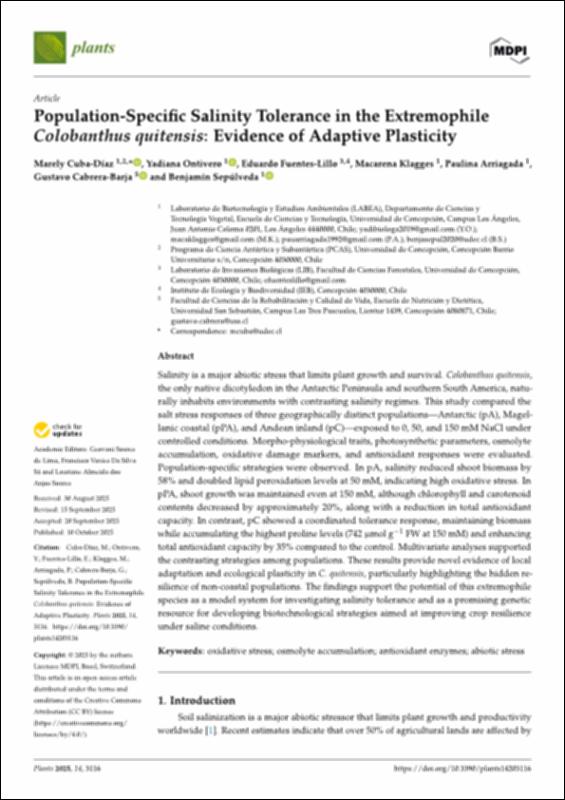
| dc.description.abstract | Salinity is a major abiotic stress that limits plant growth and survival. Colobanthus quitensis, the only native dicotyledon in the Antarctic Peninsula and southern South America, naturally inhabits environments with contrasting salinity regimes. This study compared the salt stress responses of three geographically distinct populations—Antarctic (pA), Magellanic coastal (pPA), and Andean inland (pC)—exposed to 0, 50, and 150 mM NaCl under controlled conditions. Morpho-physiological traits, photosynthetic parameters, osmolyte accumulation, oxidative damage markers, and antioxidant responses were evaluated. Population-specific strategies were observed. In pA, salinity reduced shoot biomass by 58% and doubled lipid peroxidation levels at 50 mM, indicating high oxidative stress. In pPA, shoot growth was maintained even at 150 mM, although chlorophyll and carotenoid contents decreased by approximately 20%, along with a reduction in total antioxidant capacity. In contrast, pC showed a coordinated tolerance response, maintaining biomass while accumulating the highest proline levels (742 µmol g −1 FW at 150 mM) and enhancing total antioxidant capacity by 35% compared to the control. Multivariate analyses supported the contrasting strategies among populations. These results provide novel evidence of local adaptation and ecological plasticity in C. quitensis, particularly highlighting the hidden resilience of non-coastal populations. The findings support the potential of this extremophile species as a model system for investigating salinity tolerance and as a promising genetic resource for developing biotechnological strategies aimed at improving crop resilience under saline conditions. | en |
| dc.language.iso | eng | |
| dc.relation.ispartof | vol. 14 Issue: no. 20 Pages: 3116 | |
| dc.source | Plants | |
| dc.title | Population-Specific Salinity Tolerance in the Extremophile Colobanthus quitensis : Evidence of Adaptive Plasticity | en |
| dc.type | Artículo | |
| dc.identifier.doi | 10.3390/plants14203116 | |
| dc.publisher.department | Facultad de Ciencias de la Rehabilitación y Calidad de Vida |
Este ítem aparece en la(s) siguiente(s) colección(ones)
-
Acceso Abierto USS [3006]