

- Inicio
- >
- Institucional
- >
- Acceso Abierto USS
- >
- Ver ítem
JavaScript is disabled for your browser. Some features of this site may not work without it.
Descubre información por...
Buscar documentos por...
Mostrar el registro sencillo del ítem
| dc.contributor.author | Figueroa Weitzman, Rodrigo Eugenio | |
| dc.contributor.author | Mittelmann, Jorge | |
| dc.date.accessioned | 2026-02-08T03:37:40Z | |
| dc.date.available | 2026-02-08T03:37:40Z | |
| dc.date.issued | 2025-01-31 | |
| dc.identifier.issn | 0211-2337 | |
| dc.identifier.uri | https://repositorio.uss.cl/handle/uss/20864 | |
| dc.description | Publisher Copyright: © 2025 Universidad Compultense Madrid. All rights reserved. | |
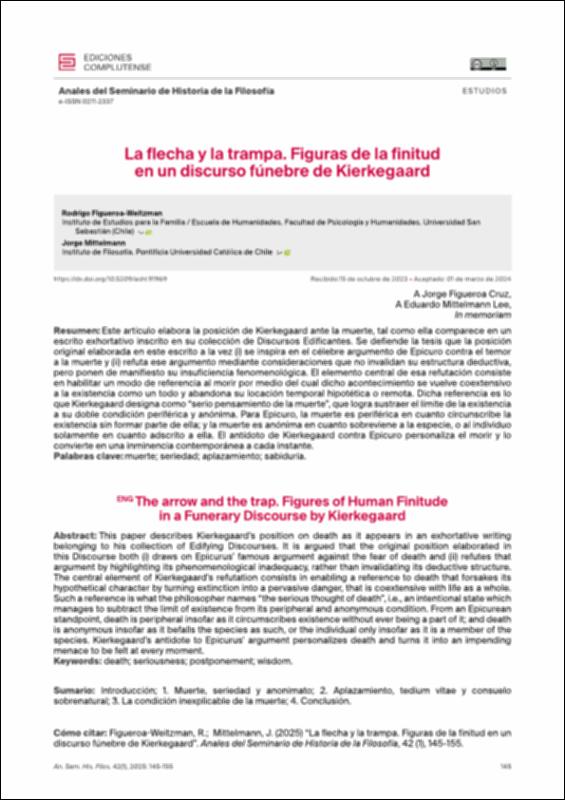
| dc.description.abstract | This paper describes Kierkegaard’s position on death as it appears in an exhortative writing belonging to his collection of Edifying Discourses. It is argued that the original position elaborated in this Discourse both (i) draws on Epicurus’ famous argument against the fear of death and (ii) refutes that argument by highlighting its phenomenological inadequacy, rather than invalidating its deductive structure. The central element of Kierkegaard’s refutation consists in enabling a reference to death that forsakes its hypothetical character by turning extinction into a pervasive danger, that is coextensive with life as a whole. Such a reference is what the philosopher names “the serious thought of death”, i.e., an intentional state which manages to subtract the limit of existence from its peripheral and anonymous condition. From an Epicurean standpoint, death is peripheral insofar as it circumscribes existence without ever being a part of it; and death is anonymous insofar as it befalls the species as such, or the individual only insofar as it is a member of the species. Kierkegaard’s antidote to Epicurus’ argument personalizes death and turns it into an impending menace to be felt at every moment. | en |
| dc.language.iso | spa | |
| dc.relation.ispartof | vol. 42 Issue: no. 1 Pages: 145-155 | |
| dc.source | Anales del Seminario de Historia de la Filosofia | |
| dc.title | La flecha y la trampa. Figuras de la finitud en un discurso fúnebre de Kierkegaard | es |
| dc.title.alternative | The arrow and the trap. Figures of Human Finitude in a Funerary Discourse by Kierkegaard | en |
| dc.type | Artículo | |
| dc.identifier.doi | 10.5209/ashf.91969 | |
| dc.publisher.department | Facultad de Psicología y Humanidades |
Este ítem aparece en la(s) siguiente(s) colección(ones)
-
Acceso Abierto USS [3006]